

Investigation
U.S. Navy Grapples with Supercarrier Shortage Amidst Ongoing Iran War
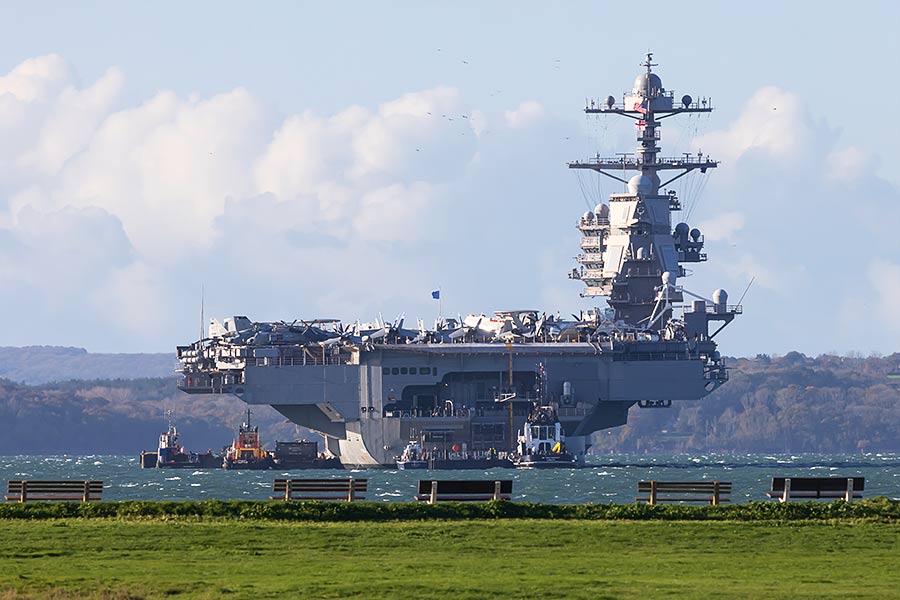
The U.S. Navy is facing significant challenges in maintaining the availability of its supercarrier fleet due to a confluence of extended deployments and maintenance backlogs, a situation that strains its ability to meet global commitments, particularly during the ongoing conflict with Iran. However, claims that the Navy is "running out" of supercarriers appear to overstate the complex reality, as the service is actively implementing strategies to sustain its legally mandated fleet size and continues to project power in the Persian Gulf region.
As of March 2026, the "Iran War" is an active military conflict initiated by the United States and Israel against Iran on February 28, 2026, involving strikes on military assets and retaliatory actions, particularly in the Middle East and the Persian Gulf region Al Jazeera, The Jerusalem Post. This conflict provides the critical context for evaluating the readiness and availability of the U.S. Navy's most powerful assets. The U.S. Navy has a statutory requirement to maintain a fleet of 11 operational aircraft carriers National Security Journal.
Current Supercarrier Status Presents Availability Challenges
Several key supercarriers are currently undergoing or are scheduled for extensive maintenance, contributing to a reduced number of deployable assets. The USS Gerald R. Ford (CVN-78), the Navy's newest aircraft carrier, was undergoing repairs in Naval Support Activity Souda Bay, Crete, in March 2026 USNI News, Navy Times. These repairs became necessary after an onboard fire on March 12, 2026, and accumulating technical strain during its nearly nine-month deployment, which began in June 2025 in support of operations against Iran USNI News, Navy Times. This extended deployment was expected to last approximately 11 months, nearing record lengths for post-Vietnam era deployments Breaking Defense.
Further exacerbating availability concerns, the Refueling and Complex Overhaul (RCOH) for the USS John C. Stennis (CVN-74), which commenced in May 2021, was 14 months behind schedule as of March 2026 USNI News, Defense News. This overhaul is now projected for redelivery in October 2026 and has incurred a budget overrun of $483 million USNI News. Looking ahead, the USS Harry S. Truman (CVN-75) is scheduled to begin its RCOH in June 2026, an overhaul expected to sideline the carrier until January 2031 Naval News, USNI News. Defense analysts and naval officials have expressed concerns that these delays and concurrent maintenance periods significantly reduce the number of available and deployable carriers, creating challenges for the U.S. Navy to meet its global commitments, particularly in regions like the Persian Gulf during ongoing conflicts Naval News, Defense News.
Navy Adapts to Maintain Fleet and Project Power
Despite these acknowledged challenges, the U.S. Navy is taking measures to ensure it maintains its legally mandated fleet of 11 operational aircraft carriers, directly challenging the notion of "running out." The service life of the USS Nimitz (CVN-68), its oldest active aircraft carrier, has been extended until March 2027 Naval Today, MyBaseGuide. This extension aims to bridge the gap until the next Ford-class carrier, the USS John F. Kennedy (CVN-79), is delivered, which is also expected in March 2027 Naval Today.
Furthermore, while the USS Gerald R. Ford did proceed to Crete for repairs, U.S. Central Command (CENTCOM) initially announced on March 12, 2026, that there was no damage to the ship's propulsion plant and that the aircraft carrier remained "fully operational" as part of ongoing air strikes on Iran U.S. Naval Forces Central Command - Navy.mil. Other ships from its strike group, including guided missile destroyers, continued operations in the region Task & Purpose. This suggests that the immediate operational impact on the ability to "fight the Iran War" was not a complete cessation of power projection. Defense experts note that the challenges are more accurately described as a "maintenance crunch" or issues with carrier availability due to extended deployments and overhauls, rather than a fundamental reduction in the total number of supercarriers The War Zone. The U.S. Navy is also actively pursuing the integration of unmanned systems, such as the MQ-25 Stingray, into its carrier air wings to increase mission capacity and enhance future combat effectiveness, indicating an evolving approach to power projection beyond sole reliance on traditional manned supercarrier operations Simple Flying.
Assessment of the Evidence
The evidence suggests a nuanced situation rather than an outright "running out" of supercarriers. There is strong, credible evidence supporting the underlying factual claims regarding the maintenance status and delays of specific U.S. Navy supercarriers, including the USS Gerald R. Ford, USS John C. Stennis, and USS Harry S. Truman USNI News, Naval News, USNI News. These individual carrier statuses, combined with the U.S. Navy's statutory requirement for 11 operational carriers and the ongoing "Iran War," provide a basis for the assertion that the Navy is facing significant challenges in maintaining a sufficient number of deployable supercarriers for current and projected global commitments Naval News.
However, the challenging evidence provides a crucial counter-narrative to the more alarmist phrasing of "running out." The verified extension of the USS Nimitz's service life directly addresses the maintenance of the statutory 11-carrier fleet Naval Today. Furthermore, the initial statement from U.S. Central Command regarding the USS Gerald R. Ford's "fully operational" status after the fire, even if temporary, indicates that the immediate impact on power projection was not a complete cessation of capability U.S. Naval Forces Central Command - Navy.mil. The distinction between the total number of carriers and their operational availability at any given moment is key. While availability is indeed constrained, the Navy is not facing a permanent depletion of its fleet. Therefore, the headline's assertion of "running out" is an overstatement, though the underlying challenges to carrier availability are well-supported.
What Remains Unclear
Despite extensive reporting, several critical details remain unclear. The precise number of deployable supercarriers the U.S. Navy currently has available for immediate tasking, considering all ongoing maintenance and repair schedules, has not been explicitly detailed by official sources. It is also not fully clear how the acknowledged "challenges with carrier availability" translate into concrete operational limitations or delays for specific missions in the Iran War, beyond the general notion of "impairment." Furthermore, the speed and effectiveness with which the U.S. Navy's evolving strategies, such as the integration of unmanned systems, can compensate for any temporary reduction in manned carrier presence in high-demand regions like the Persian Gulf are yet to be fully demonstrated and quantified.