

Reporting
Trump Truth Social Post Sparking Backlash Over Federal Data Center Fast-Tracking
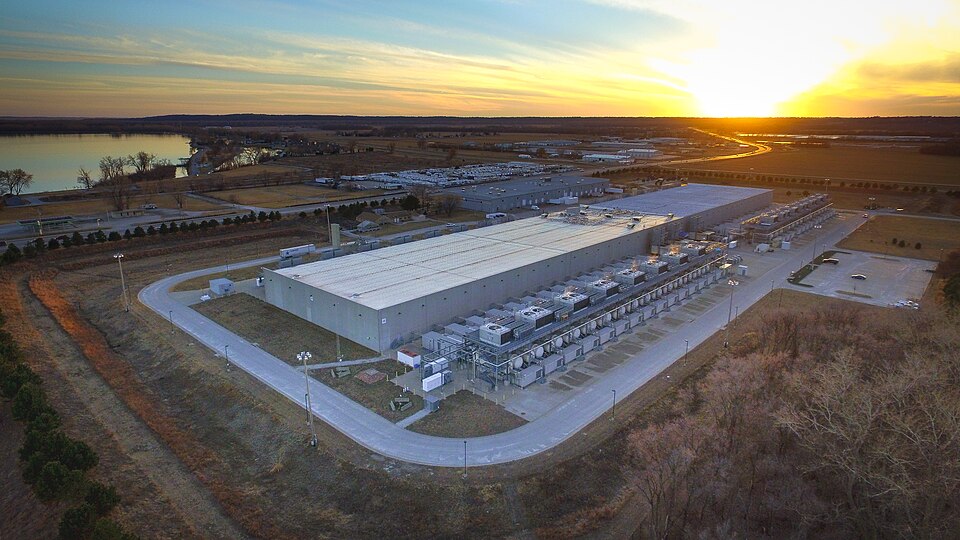
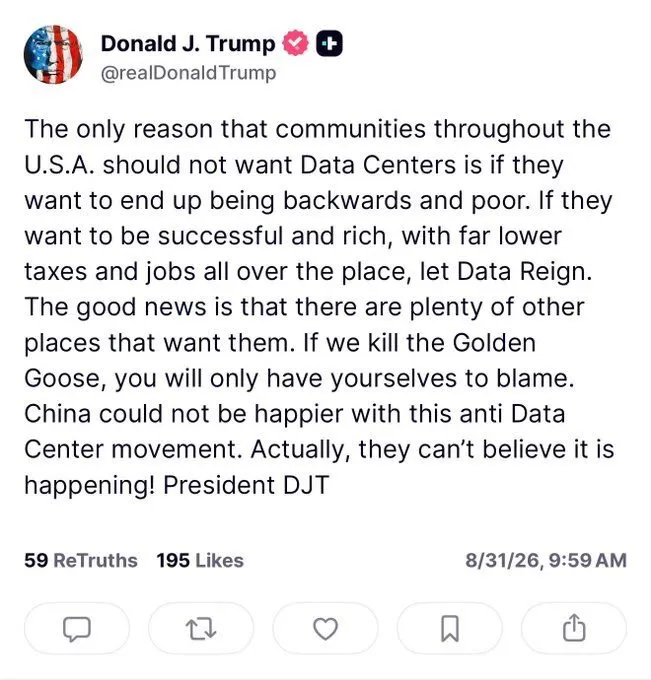
WASHINGTON — On August 31, 2026, Donald Trump issued a sharp warning on Truth Social against growing local opposition to data centers, declaring that communities rejecting the facilities risk becoming "backwards and poor" while handing a strategic advantage to China.
The statement has intensified a rare political backlash among his own core supporters and local conservative activists, who are actively fighting data center expansions across the country.
In his social media post, Trump attacked the "anti Data Center movement" and urged local communities to "let Data Reign" to secure lower taxes and abundant jobs.
The warning comes as a late August 2026 Economist/YouGov poll revealed that 47 percent of Trump voters oppose local data center construction, driven by concerns over water depletion, noise, and rising utility bills.
This grassroots resistance has found legislative expression in states like New Jersey, where Governor Mikie Sherrill signed a law on August 27, 2026, requiring data centers to report their water and electricity consumption to the state's Board of Public Utilities every six months.
While framed by supporters as a national model for transparency, the New Jersey measure contains a major loophole in the legislative text that limits public access to the reported utility data under the state's Open Public Records Act.
Furthermore, local environmental critics reported that the legislation fails to mandate independent audits of the submitted data or impose actual caps on resource consumption.
The conflict stems from a year-long federal push to bypass local and environmental hurdles, anchored by Executive Order 14318, which Trump signed in July 2025 to accelerate permitting.
In mid-2026, the Environmental Protection Agency proposed rules to eliminate public notice and comment periods for minor-source air permits covering diesel backup generators.
To justify this rapid expansion, industry proponents have pointed to massive local tax windfalls, such as the $1.3 billion in annual tax revenue projected for Loudoun County, Virginia.
Supporters have also circulated claims that data center municipal tax funding caused the poverty rate in Quincy, Washington, to collapse from 29 percent to 6 percent.
However, official U.S. Census Bureau data contradicts those claims, showing Quincy's poverty rate actually fell to 13.1 percent as of 2023, with agriculture remaining the primary regional employer.
On the environmental front, prominent tech investor Gavin Baker recently walked back previous aggressive comments, acknowledging that there are reasonable concerns about data center resource consumption.
While Baker and other industry advocates argue that modern closed-loop cooling systems drastically cut net water volume usage, a legal and technical brief noted that these systems introduce new risks by generating highly concentrated chemical wastewater discharges.
Despite federal efforts to fast-track these projects, legal experts emphasize that executive actions cannot override state and local authority over zoning, land use, or municipal utility regulations.
Republican lawmakers, including Senator Katie Britt of Alabama, have publicly pushed back against top-down federal permitting to protect local ratepayers from rising utility costs.
Legal challenges from environmental groups are currently mounting against the EPA's proposed air permit rule changes, with federal courts expected to rule on the validity of the fast-track policies later this year.