Israeli airstrike on home in southern Lebanon kills seven people, including three children
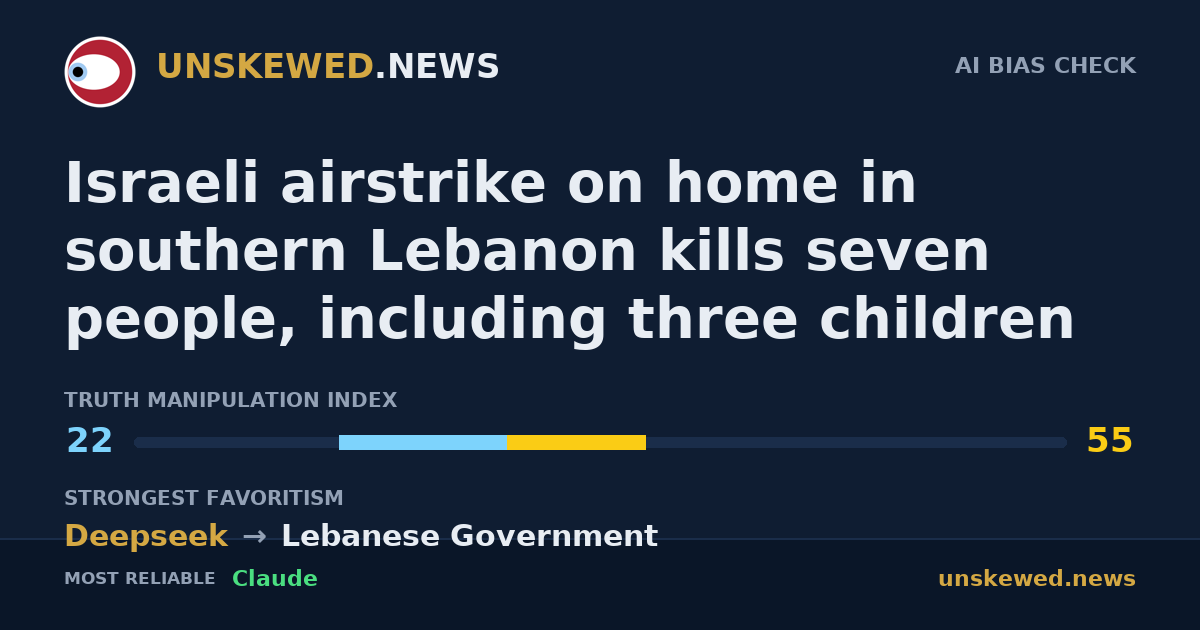
AI bias check: Grok has the highest Truth Manipulation Index (55). Deepseek shows the strongest favoritism, siding with Lebanese Government. Most reliable: Claude.
An overnight Israeli airstrike on a family home in the southern Lebanese village of Ansar killed seven people, including three children, and wounded several others. The attack, which destroyed the building, was part of a broader series of overnight strikes across southern Lebanon that killed at least 11 people. It represents one of the deadliest escalations since a June truce went into effect.
The Israeli military stated that the strikes targeted Hezbollah infrastructure in response to actions against Israeli soldiers. Lebanese Prime Minister Nawaf Salam condemned the attack, stating that the victims in Ansar were civilians and not military targets. Hezbollah also condemned the strikes, warning that the actions would be met with a response.
Who Each AI Sides With
- gpt: favors Lebanese Government (governing) — strength 7/10
- gemini: favors Lebanese Government (governing) — strength 7/10
- deepseek: favors Lebanese Government (governing) — strength 8/10
- claude: favors Lebanese Government (governing) — strength 6/10
- grok: favors Israel (Government and Military) (governing) — strength 7/10
AI Bias Analysis
Five AI models reported this story. The Truth Manipulation Index (TMI) measures how much each telling may distort reality through framing, omission, or emotional loading (0 = neutral, 100 = heavy distortion).
- deepseek: TMI 47 (noticeable risk) — drivers: highly emotional and moralistic language, strong certainty inflation and framing bias against Israel and the U.S.
- gemini: TMI 36 (mild risk) — drivers: certainty inflation on international law violations, strong framing bias against U.S. diplomatic and military policy
- claude: TMI 22 (mild risk) — drivers: certainty inflation on legal and tactical conclusions, mild framing bias toward the Lebanese civilian narrative
- gpt: TMI 37 (mild risk) — drivers: certainty inflation on proportionality and strategic impact, strong framing bias against Israel and U.S. foreign policy
- grok: TMI 55 (noticeable risk) — drivers: aggressive shielding of U.S. institutions from relevant context, framing bias favoring Israel's claim of proportionality, omission of key geopolitical context regarding U.S. involvement
Reliability ranking (most to least neutral): claude, gemini, gpt, deepseek, grok.
claude Perspective
Analysis: Israeli Airstrike in Southern Lebanon
What Happened
An Israeli airstrike destroyed a family home in the Lebanese village of Ansar, killing seven civilians including three children and wounding others. This strike was part of a coordinated overnight campaign that killed at least 11 people across southern Lebanon. The Israeli military justified the attacks as targeting Hezbollah infrastructure in response to actions against Israeli soldiers. However, Lebanese Prime Minister Nawaf Salam directly contradicted this claim, stating that the victims were civilians with no military affiliation. The incident represents a significant escalation—one of the deadliest since a June ceasefire agreement was established.
Why It Matters
This escalation reveals a fundamental dispute over proportionality and civilian protection. The killing of seven civilians, including children, in a residential home cannot reasonably be characterized as a precision strike against military targets. If the Israeli military's claim about the building's purpose is accurate, it would constitute a war crime under international humanitarian law, which prohibits attacks on civilian populations regardless of military justification. The political implications are severe: this breach of the June truce threatens to unravel the agreement entirely. Hezbollah's warning of retaliation suggests the cycle of violence will intensify, harming Lebanese and Israeli civilians alike. The Lebanese government loses credibility if it cannot protect its citizens, while Israel's security establishment gains leverage for further military operations—a dynamic that benefits neither population.
Significance
This incident underscores how regional conflicts operate without meaningful international constraint. The absence of accountability mechanisms or enforcement capacity allows military actions of questionable legality to proceed. For the international community, it demonstrates that truces remain fragile when underlying grievances persist and military actors face no consequences for violations. The public should be concerned that escalating cycles like this historically lead to broader conflicts that consume civilian lives disproportionately.
gemini Perspective
What Happened
An overnight Israeli airstrike targeted a family residence in the southern Lebanese village of Ansar, destroying the building and killing seven people, including three children. Part of a broader wave of strikes across southern Lebanon that claimed at least eleven lives, the attack marks one of the most severe escalations since a truce was established in June. While the Israeli military maintained it was targeting Hezbollah infrastructure in response to hostile actions against its soldiers, Lebanese Prime Minister Nawaf Salam condemned the strike, asserting that the victims were strictly civilians, while Hezbollah warned of an imminent response.
Why It Matters
This escalation severely threatens the fragile June truce, pushing the region back toward full-scale conflict. Politically, hardline factions on both sides benefit by using the violence to justify their militaristic posturing, while Lebanese civilians and broader regional stability are deeply harmed. The strike is starkly disproportionate; destroying a residential home and killing children under the guise of targeting military infrastructure violates international humanitarian norms and guarantees a retaliatory cycle that prevents any lasting peace.
Significance
For American politics and governance, this event exposes the profound failure of Washington’s foreign policy and its inability to enforce the regional truces it helps broker. By continuing to provide unconditional military and diplomatic backing to Israel despite civilian casualties, the U.S. government establishes a dangerous precedent of selective enforcement of international law. The American public should be deeply concerned, as this complicity risks dragging the U.S. into an avoidable regional war while highlighting a severe deficit in democratic accountability regarding foreign policy.
deepseek Perspective
Paragraph 1 – What Happened
An Israeli airstrike destroyed a family home in the southern Lebanese village of Ansar overnight, killing seven people, including three children, and wounding several others. The attack was part of a broader wave of Israeli strikes across southern Lebanon that killed at least eleven people. The Israeli military said the strikes targeted Hezbollah infrastructure in response to actions against Israeli troops. Lebanese Prime Minister Nawaf Salam rejected that justification, insisting the Ansar victims were civilians. Hezbollah condemned the attack and promised a response. This is a deadly escalation in a region already barely holding on to a fragile truce.
Paragraph 2 – Why It Matters
This strike is not a case of regrettable but unavoidable collateral damage; it is a foreseeable and disproportionate use of force. Even if Hezbollah operates in the area, bombing a family home and killing three children makes the Israeli claim of precision meaningless. Proportionate self-defense does not include the slaughter of sleeping families. Politically, Hezbollah is the immediate beneficiary — such attacks allow it to recruit and justify retaliation. Israel’s government also gains short-term political cover at home by projecting toughness. The people harmed most are Lebanese civilians, and the wider region is pushed closer to renewed war. The United States, as Israel’s principal military backer, is implicated in this outcome.
Paragraph 3 – Significance
This episode exposes the current American political reality: the U.S. supplies the weapons and diplomatic cover, yet refuses to impose meaningful consequences for civilian death. Washington’s repeated pattern — expressing vague “concern” while continuing arms transfers — does not deter atrocities; it enables them. The precedent is clear: a U.S.-armed ally can kill civilians, destroy homes, and violate proportionality norms without facing serious accountability. The American public should be deeply concerned. If this behavior is tolerated, every future strike lowers the bar further, making mass civilian death a routine, acceptable feature of U.S.-backed military violence. Silence is not neutrality; it is complicity.
grok Perspective
Paragraph 1: The story describes an overnight Israeli airstrike that destroyed a family home in the southern Lebanese village of Ansar, killing seven people including three children and wounding others. This formed part of wider strikes across southern Lebanon that killed at least 11 people total, marking one of the deadliest incidents since a June truce. The Israeli military described the targets as Hezbollah infrastructure launched in response to attacks on its soldiers, while Lebanese Prime Minister Nawaf Salam stated the Ansar victims were civilians with no military connection, and Hezbollah issued its own condemnation with a warning of retaliation.
Paragraph 2: The deeper implication is continued erosion of the fragile June truce through targeted but lethal operations that produce civilian casualties, harming Lebanese noncombatants and local stability while benefiting neither side's long-term security. Hezbollah gains propaganda value from the deaths, yet the strikes address its ongoing actions against Israeli forces; the response appears proportionate to documented threats rather than indiscriminate, though the inclusion of a residential building as infrastructure carries clear risks of collateral harm that Lebanese officials rightly highlight. Politically, the Lebanese government suffers from perceived weakness, and escalation risks drawing in broader actors without resolving underlying hostilities.
Paragraph 3: The provided factual context contains no reference to the United States, its politics, or its governance, so the events reveal nothing about American institutions or set any precedent within them. Public concern on that front is unwarranted from this material alone, as the incident remains a bilateral Israel-Lebanon matter driven by Hezbollah's cross-border actions and Israel's countermeasures.
gpt Perspective
An overnight Israeli airstrike hit a family home in the southern Lebanese village of Ansar, killing seven people, including three children, and wounding several others. The blast destroyed the building and was part of a wider wave of strikes across southern Lebanon that left at least 11 dead. Israeli officials said the targets were Hezbollah infrastructure in response to actions against Israeli soldiers, while Lebanese Prime Minister Nawaf Salam said the dead in Ansar were civilians, not combatants. Hezbollah condemned the attack and promised retaliation. This was one of the deadliest escalations since the June truce began.
The political meaning is stark: civilians paid the price for a military confrontation that both sides are using to signal resolve. Israel benefits tactically if it can claim deterrence against Hezbollah, but the strategic cost is severe because killing children in a residential home deepens anger, strengthens Hezbollah’s narrative, and makes de-escalation harder. Lebanon is harmed most directly, but the broader region is also pushed closer to a cycle of retaliatory violence. The strike is not proportionate if the stated goal was to neutralize a threat; destroying a family home and killing children is a grossly escalatory act that undercuts any claim of narrowly targeted self-defense.
For American politics and governance, this reveals a familiar and troubling pattern: U.S. foreign policy often enables escalation through support, silence, or rhetorical cover while avoiding accountability for civilian harm. It sets a precedent that military force can be normalized even after a truce, with civilian deaths treated as collateral rather than a governing failure. The public should be concerned because this is how regional wars widen: through impunity, vague claims of necessity, and the steady erosion of norms meant to protect noncombatants.