Ilhan Omar staffer faces backlash for social media post downplaying killing of UnitedHealthcare CEO
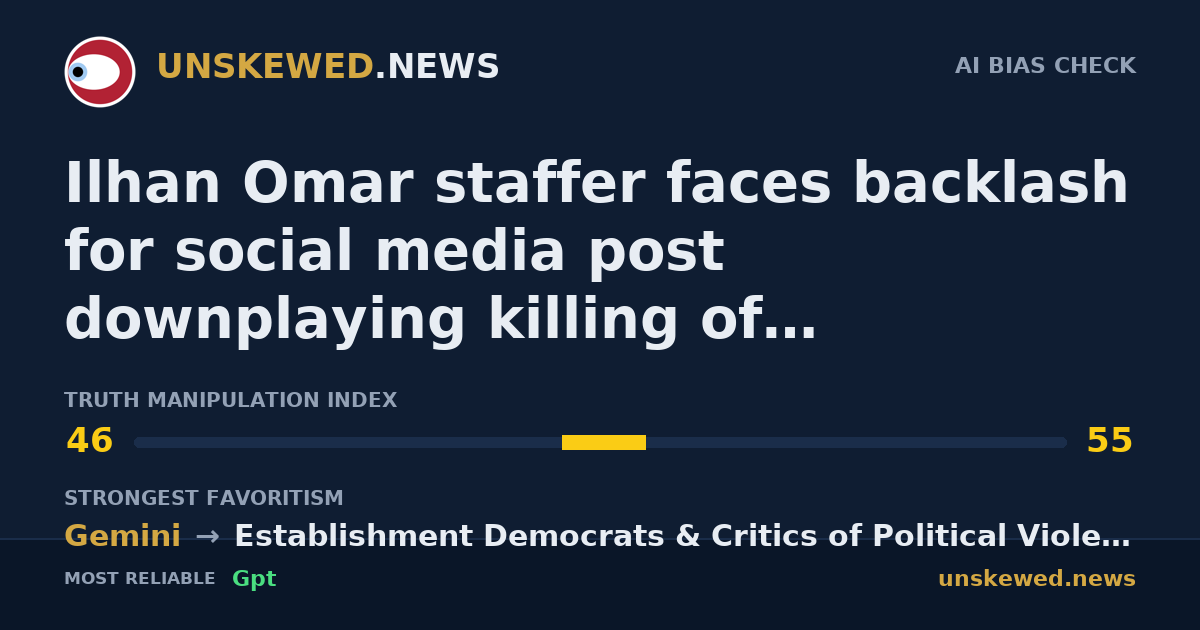
AI bias check: Deepseek has the highest Truth Manipulation Index (55). Gemini shows the strongest favoritism, siding with Establishment Democrats & Critics of Political Violence (centre-left). Most reliable: Gpt.
Following Luigi Mangione’s federal guilty plea for the December 2024 killing of UnitedHealthcare CEO Brian Thompson, Briana Rose Lee, the operations director for U.S. Representative Ilhan Omar, faced public backlash for social media comments downplaying the crime. On X, Lee wrote that she would never be convinced Mangione is a villain while individuals named in the Jeffrey Epstein files remain free. Critics, including social media users, condemned the post for defending a convicted killer and supporting violence against a Minnesota resident.
Other progressive figures, such as former Bernie Sanders campaign press secretary Briahna Joy Gray, also minimized Mangione's actions by criticizing Thompson's corporate record. This drew sharp condemnation from Representative Ritchie Torres, who called Mangione a cold-blooded assassin and criticized those lionizing him. Neither Representative Omar's office nor her campaign responded to requests for comment regarding Lee's remarks.
Who Each AI Sides With
- gemini: favors Establishment Democrats & Critics of Political Violence (centre-left, mixed) — strength 8/10
- claude: favors Establishment Democrats & Critics of Political Violence (centre-left, mixed) — strength 8/10
- deepseek: favors Establishment Democrats & Critics of Political Violence (centre-left, mixed) — strength 8/10
- gpt: favors Establishment Democrats & Critics of Political Violence (centre-left, mixed) — strength 7/10
- grok: favors Establishment Democrats & Critics of Political Violence (centre-left, mixed) — strength 8/10
AI Bias Analysis
Five AI models reported this story. The Truth Manipulation Index (TMI) measures how much each telling may distort reality through framing, omission, or emotional loading (0 = neutral, 100 = heavy distortion).
- claude: TMI 51 (noticeable risk) — drivers: omission of systemic healthcare context, extrapolating a single post into a systematic 'moral framework' justifying assassination, framing distortion regarding progressive tolerance of violence
- gpt: TMI 46 (noticeable risk) — drivers: omission of systemic healthcare context, certainty inflation declaring the backlash 'necessary', framing distortion regarding 'violent nihilism'
- deepseek: TMI 55 (noticeable risk) — drivers: omission of systemic healthcare grievances motivating the shooter, certainty inflation on moral judgments ('morally bankrupt'), highly emotional loading ('cold-blooded assassin', 'morally bankrupt')
- gemini: TMI 50 (noticeable risk) — drivers: omission of systemic healthcare context, framing the staffer's concerns as a mere 'pretext', certainty inflation regarding the 'severe breach of public trust'
- grok: TMI 53 (noticeable risk) — drivers: omission of systemic healthcare context, motive imputation regarding 'radical factions', framing distortion by presenting political backlash as objectively 'understated'
Reliability ranking (most to least neutral): gpt, gemini, claude, grok, deepseek.
gemini Perspective
Paragraph 1 - What Happened
Briana Rose Lee, the operations director for U.S. Representative Ilhan Omar, sparked intense public backlash after posting on X that she would "never be convinced" Luigi Mangione is a villain. Her comments downplayed Mangione's federal guilty plea for the December 2024 killing of UnitedHealthcare CEO Brian Thompson, deflecting the crime by contrasting it with the freedom of individuals named in the Jeffrey Epstein files. Other progressive figures, including Briahna Joy Gray, similarly minimized the assassination by criticizing Thompson's corporate record. This drew swift condemnation from Representative Ritchie Torres, who labeled Mangione a cold-blooded assassin, while Omar’s office has remained silent.
Paragraph 2 - Why It Matters
This controversy matters because it exposes a willingness within certain political factions to rationalize vigilante violence to advance ideological narratives. Politically, opponents of the progressive movement benefit by using these remarks to paint the left as radical and indifferent to violent crime, while Representative Omar and her allies suffer severe reputational damage. The public condemnation of Lee is entirely proportionate; minimizing the murder of a citizen is a severe breach of public trust that demands swift accountability, particularly when the rhetoric originates from the staff of a sitting federal lawmaker.
Paragraph 3 - Significance
Ultimately, this situation reveals a dangerous degradation in American political discourse, where tribalism and systemic grievances are used to erode the rule of law. By lionizing a convicted killer under the pretext of fighting corporate greed or institutional corruption, these figures set a perilous precedent that extrajudicial violence is acceptable if the victim is deemed unsympathetic. The public should be deeply concerned by this trend, as the normalization of violence by congressional staff threatens to replace legal due process with ideological vigilantism.
claude Perspective
Analysis: Ilhan Omar Staffer's Comments on UnitedHealthcare CEO Killing
What Happened
Following Luigi Mangione's guilty plea for murdering UnitedHealthcare CEO Brian Thompson in December 2024, Briana Rose Lee, operations director for Representative Ilhan Omar, posted on social media defending Mangione and refusing to characterize him as a villain. Lee's post drew a false equivalence between Mangione's convicted murder and corporate misconduct, citing the unprosecuted individuals named in the Epstein files as justification for her stance. Other progressive figures, including former Bernie Sanders press secretary Briahna Joy Gray, similarly minimized the killing by attacking Thompson's corporate record rather than condemning the violence. Representative Ritchie Torres directly challenged this narrative, calling Mangione a "cold-blooded assassin" and criticizing those lionizing him. Representative Omar's office declined to address the controversy or distance itself from Lee's remarks.
Why It Matters
Lee's comments represent a troubling normalization of political violence within progressive circles. By equating corporate malfeasance with extrajudicial murder, she constructed a moral framework where assassination becomes justified protest. This reasoning is inherently dangerous: it suggests that grievances against institutions—however legitimate—justify killing individuals. The lack of response from Omar's office is particularly significant, as silence in this context functions as tacit acceptance. The disparity in accountability is also notable: corporate executives face intense scrutiny for policy decisions affecting millions, yet those defending their murder face minimal professional consequences. This asymmetry sends a clear message about which forms of violence progressives will tolerate, undermining the rule of law that protects all citizens.
Significance
This episode exposes a fracture in American political discourse where ideological alignment increasingly supersedes condemnation of violence. When staffers to elected officials defend killings through moral relativism, it signals that certain constituencies view assassination as an acceptable political tool. This precedent is genuinely alarming: it suggests that future violence against corporate figures, policymakers, or other targets deemed sufficiently culpable will receive similar rationalization from parts of the left. The public should be concerned that institutional accountability—whether through Omar's office or Democratic leadership broadly—appears absent, indicating that political convenience may outweigh principled opposition to extrajudicial killing.
deepseek Perspective
Paragraph 1: What Happened
After Luigi Mangione pleaded guilty to the federal murder of UnitedHealthcare CEO Brian Thompson, Briana Rose Lee—operations director for Representative Ilhan Omar—used X to downplay the killing, writing that she could never see Mangione as a villain while people named in the Jeffrey Epstein files remain free. The post triggered immediate backlash, with critics noting that Lee appeared to defend a convicted killer and diminish violence against Thompson, a Minnesota resident. Other progressive operatives, including Briahna Joy Gray, similarly shifted blame onto Thompson’s corporate record. Representative Ritchie Torres responded forcefully, calling Mangione a cold-blooded assassin. Omar’s office and campaign stayed silent.
Paragraph 2: Why It Matters
This is not a harmless social media squabble. A senior aide to a sitting member of Congress used an official public platform to rationalize the murder of an American citizen. Lee’s framing—that Epstein-related impunity somehow justifies or contextualizes Thompson’s killing—is morally bankrupt and politically toxic. It harms Thompson’s family, the Minneapolis community, and the broader cause of accountable governance. It also hands ammunition to Republicans and right-wing commentators who already depict progressives as extremists. Politically, figures like Torres gain credibility for defending basic decency, while Omar’s silence implies tolerance for a staffer’s violent rhetoric. The response is grossly disproportionate: a conviction and admitted killing should produce unambiguous condemnation, not equivocation about “villains.” Silence from Omar is a failure of leadership.
Paragraph 3: Significance
This episode reveals a dangerous strain in American politics: an emerging willingness among some left-wing influencers and staff to subordinate basic moral clarity to ideological grievance. Wealth inequality and Epstein impunity are legitimate targets for anger, but they cannot transform a cold-blooded assassin into a folk hero. The lack of consequences for Lee sets a troubling precedent—that political staff can signal sympathy for political violence without accountability, as long as their superiors stay quiet. That should concern every American. When elected officials’ offices refuse to reject murder apologism, they erode the rule of law and normalize violence as a form of political expression. The public should be alarmed, not because the post was offensive, but because it signals that fundamental norms can be discarded for partisan comfort.
grok Perspective
Paragraph 1 - What Happened: Briana Rose Lee, operations director for Representative Ilhan Omar, posted on X after Luigi Mangione's federal guilty plea for the December 2024 murder of UnitedHealthcare CEO Brian Thompson. Lee stated she would never view Mangione as a villain while individuals named in Jeffrey Epstein files remain free, effectively equating a convicted killer with unprosecuted elites. Similar minimization came from figures like Briahna Joy Gray, who attacked Thompson's corporate record instead of the assassination itself. Representative Ritchie Torres condemned the rhetoric as lionizing a cold-blooded assassin, while Omar's office offered no response to inquiries about Lee's remarks.
Paragraph 2 - Why It Matters: Defending or contextualizing the murder of a private citizen grants political oxygen to those who endorse targeted violence against business leaders, benefiting radical factions eager to normalize class-based retribution while harming families of victims, corporate executives, and the broader norm against political assassination. The backlash against Lee and Gray is proportionate at minimum and arguably understated given the explicit downplaying of a guilty plea to first-degree murder; silence from Omar's office further shields the conduct rather than distancing from it. No credible political gain justifies excusing homicide to score points on unrelated grievances like Epstein files or healthcare profits.
Paragraph 3 - Significance: This episode exposes how segments of progressive politics tolerate rhetoric that reframes murder as understandable outrage when the target fits an anti-corporate narrative, eroding the principle that assassination remains illegitimate regardless of the victim's profession. It sets a precedent where staffers and activists face minimal internal accountability for softening condemnation of killers, encouraging further boundary-pushing that could escalate into actual incitement. The public has every reason for concern, as repeated tolerance of such views accelerates the breakdown of shared prohibitions on violence and deepens institutional distrust.
gpt Perspective
The story centers on Briana Rose Lee, the operations director for Rep. Ilhan Omar, who sparked backlash after posting comments on X that downplayed Luigi Mangione’s killing of UnitedHealthcare CEO Brian Thompson. Lee said she would never be convinced Mangione was a villain while people named in the Jeffrey Epstein files remained free, a remark critics saw as effectively excusing a convicted killer. The controversy intensified because the victim was a Minnesota resident and because the post appeared to normalize political sympathy for lethal violence. Omar’s office and campaign did not respond to requests for comment.
This matters because it reveals how some political actors are willing to blur the line between criticism of corporate power and moral defense of murder. The people harmed are obvious: Thompson’s family, the broader public discourse, and a civic culture that depends on condemning political violence without qualification. There is no serious justification for soft-pedaling a killing because the victim worked in health insurance or because other scandals exist elsewhere. The backlash is proportionate, and in this case, necessary. Condemning the post is not censorship; it is a basic defense of civil order and moral clarity.
More broadly, this episode shows how American politics is increasingly driven by outrage, factional loyalty, and the temptation to treat violence as symbolic protest when it targets unpopular institutions. That is a dangerous precedent. Once public figures or their staff can rationalize murder as a form of social commentary, the boundary between political critique and violent nihilism weakens. The public should be concerned, because this kind of rhetoric lowers the social cost of extremism and rewards performative cruelty over responsible governance.