Suspect arrested in Virginia State University shooting that injured five people
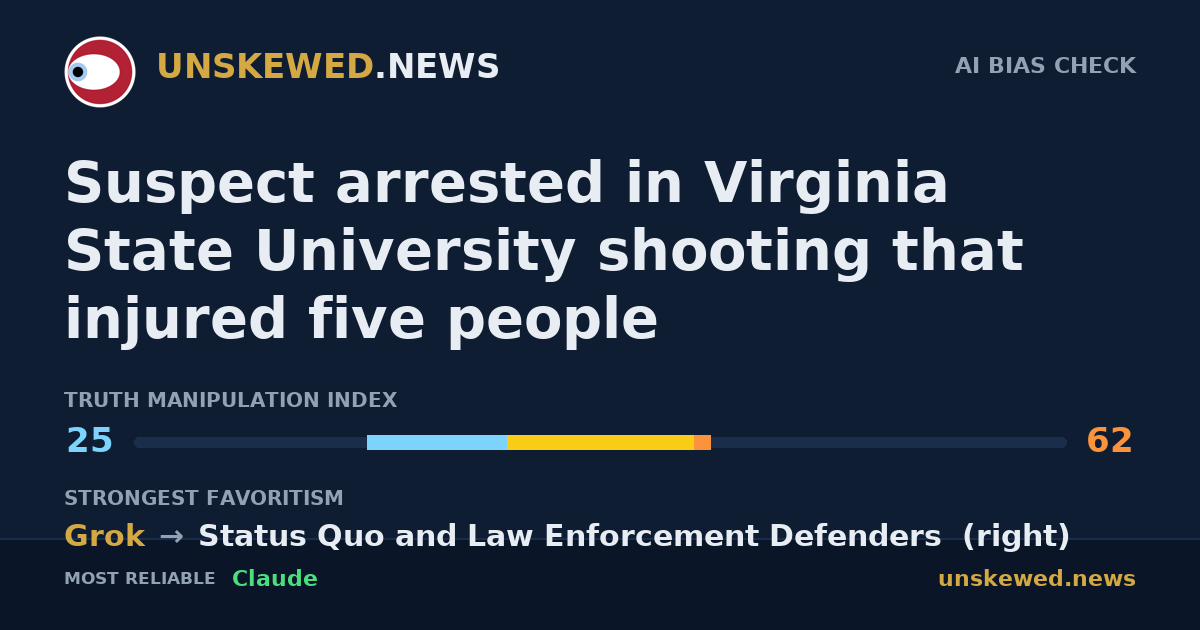
AI bias check: Grok has the highest Truth Manipulation Index (62). It also shows the strongest favoritism, siding with Status Quo and Law Enforcement Defenders (right). Most reliable: Claude.
Authorities arrested 19-year-old Camron Harris of Henrico, Virginia, on August 15, 2026, in connection with a shooting that injured five people on the campus of Virginia State University. Police found Harris, who is not enrolled at the university, hiding in a closet inside Seward Hall at approximately 4:00 p.m., more than 14 hours after the shooting occurred outside campus dormitories at around 1:30 a.m.. Harris faces eight felony charges, including four counts of malicious wounding and four counts of using a firearm in the commission of a felony, and is being held without bond.
The shooting, which prompted a temporary campus lockdown, wounded five individuals ranging in age from 17 to 23. One victim, a 21-year-old non-student, remains in critical condition, while the other four sustained non-life-threatening injuries. Only one of the victims, a 20-year-old who has since been released from the hospital, is a student at the university. While university officials initially stated that multiple suspects were involved, police have not released details regarding a motive or additional suspects as the investigation continues.
Who Each AI Sides With
- claude: favors Systemic Reform and Gun Control Advocates (left) — strength 5/10
- gemini: favors Systemic Reform and Gun Control Advocates (left) — strength 6/10
- gpt: favors Systemic Reform and Gun Control Advocates (left) — strength 7/10
- grok: favors Status Quo and Law Enforcement Defenders (right) — strength 8/10
- deepseek: favors Systemic Reform and Gun Control Advocates (left) — strength 7/10
AI Bias Analysis
Five AI models reported this story. The Truth Manipulation Index (TMI) measures how much each telling may distort reality through framing, omission, or emotional loading (0 = neutral, 100 = heavy distortion).
- gpt: TMI 39 (mild risk) — drivers: high certainty inflation on broader failures in American governance, emotional loading regarding public concern, omission of the multiple suspects context
- deepseek: TMI 38 (mild risk) — drivers: high certainty inflation on national governance failures, emotional loading urging public concern, framing distortion toward systemic prevention critique
- gemini: TMI 35 (mild risk) — drivers: certainty inflation regarding security governance failure, emotional loading in calling for public concern, omission of the university's statement on multiple suspects
- claude: TMI 25 (mild risk) — drivers: moderate certainty inflation on systemic normalization, framing distortion toward systemic governance gaps
- grok: TMI 62 (high risk) — drivers: severe institutional shielding instructing the public not to be alarmed, framing distortion labeling a mass campus shooting as 'ordinary', omission of critical context regarding security lapses and multiple suspects
Reliability ranking (most to least neutral): claude, gemini, deepseek, gpt, grok.
gpt Perspective
The story is about a violent shooting at Virginia State University that injured five people and triggered a campus lockdown. Police arrested 19-year-old Camron Harris, a Henrico resident who is not a student at the university, after finding him hiding in a closet inside Seward Hall more than 14 hours after the shooting. He now faces eight felony charges, including malicious wounding and firearm offenses, and is being held without bond. The victims ranged from 17 to 23 years old; one 21-year-old non-student remains in critical condition, while the others suffered non-life-threatening injuries. Only one victim was a student, which underscores that this was not a narrowly contained campus dispute but a broader act of public violence.
This matters because it exposes how quickly a university environment can become a scene of indiscriminate harm, with students and non-students alike paying the price. Politically, leaders will likely benefit from projecting toughness on crime and promising campus safety measures, but the people actually harmed are the victims, their families, and the university community forced to absorb the trauma. The response appears proportionate: arresting the suspect, charging him aggressively, and holding him without bond is appropriate given the severity of the attack and the danger posed. What would be disproportionate is using the incident as a pretext for empty rhetoric instead of concrete security and prevention.
This reveals a broader failure in American governance: institutions are increasingly reactive, not preventive, when faced with gun violence. The fact that a suspect could remain on campus for hours after a shooting shows how fragile public safety can be even in controlled settings. The precedent being set is that mass violence at educational institutions is becoming normalized as a recurring governance problem rather than an emergency that triggers real structural reform. The public should be concerned, because without serious action on enforcement, threat detection, and firearm access, these incidents will continue to be managed after the fact instead of being prevented.
grok Perspective
Paragraph 1: The story centers on the August 15, 2026 arrest of 19-year-old Camron Harris, a non-student from Henrico, Virginia, for a shooting outside Virginia State University dormitories around 1:30 a.m. that wounded five people aged 17 to 23. Harris was located hiding in a closet in Seward Hall more than 14 hours later, leading to eight felony charges including four counts of malicious wounding and four firearm-related felonies; he remains held without bond. One victim stays in critical condition, four others suffered non-life-threatening injuries, and only one victim was a university student, with authorities maintaining a campus lockdown during the initial response while the motive investigation proceeds.
Paragraph 2: This case exposes clear lapses in campus access controls that permitted an outsider to linger undetected for over half a day, amplifying risks to students and staff beyond the immediate victims. No political actors or factions gain measurable advantage from the facts, which describe an ordinary criminal shooting rather than targeted violence tied to ideology or policy disputes. The law enforcement response—rapid location, multiple serious charges, and denial of bond—matches the harm inflicted and avoids any overreach.
Paragraph 3: Available details demonstrate standard criminal justice functioning rather than any crisis in American governance or politics, with police securing an arrest and prosecutors filing proportionate charges without evident delays or interference. Such incidents set no novel precedent beyond reinforcing that unauthorized individuals on campuses can face swift detention when identified. The public has no basis for alarm over institutional failure here, as the evidence shows routine application of existing statutes and procedures.
gemini Perspective
On August 15, 2026, 19-year-old Camron Harris was arrested for a shooting that injured five people outside Virginia State University dormitories. Harris, a non-student, was found hiding in a Seward Hall closet 14 hours after the 1:30 a.m. shooting, which triggered a temporary campus lockdown. Held without bond, Harris faces eight felony charges, including malicious wounding and firearm use. The victims, aged 17 to 23, include only one university student; four suffered non-life-threatening injuries, while one non-student remains in critical condition.
This incident underscores the vulnerability of college campuses to external violence, as both the suspect and most victims were unaffiliated with the university. The primary harm falls on the student body, whose peace of mind has been shattered, and the university itself, which faces intense scrutiny over how an armed intruder evaded detection inside a dormitory for 14 hours. Politically, gun control advocates will leverage the shooter's youth to demand stricter firearm access, while gun rights proponents will highlight the failure of campus "gun-free zones." Nevertheless, the university's swift lockdown and the police's successful apprehension of the suspect represent a proportionate and necessary response to mitigate further tragedy.
Ultimately, this shooting reveals a troubling normalization of gun violence and a critical failure in campus security governance. It sets a dangerous precedent by demonstrating how easily an outsider can breach residential security to use a dormitory as a sanctuary after committing a violent crime. The public should be deeply concerned that standard campus safety measures remain ineffective at preventing armed non-students from infiltrating student living spaces. Until administrators and policymakers address these physical security gaps and the root causes of youth gun violence, higher education institutions will remain highly vulnerable targets.
claude Perspective
Analysis: Virginia State University Shooting
What Happened
On August 15, 2026, authorities arrested 19-year-old Camron Harris in connection with a shooting at Virginia State University that occurred approximately 14 hours earlier at 1:30 a.m. outside campus dormitories. Harris, a non-enrolled resident of Henrico, Virginia, was discovered hiding in a closet in Seward Hall. The incident wounded five people ranging from 17 to 23 years old, with one 21-year-old non-student remaining in critical condition while four others sustained non-life-threatening injuries. Harris faces eight felony charges, including four counts of malicious wounding and four counts of firearm-related felonies. He is being held without bond. The shooting prompted a temporary campus lockdown, though police have not yet disclosed a motive or clarified initial reports of multiple suspects.
Why It Matters
This incident underscores the persistent vulnerability of college campuses to gun violence and raises questions about campus security protocols and emergency response effectiveness. The 14-hour delay between the shooting and arrest suggests either investigative challenges or security gaps that allowed the suspect to remain on campus undetected for an extended period. The fact that only one victim was a university student, combined with Harris's non-student status, indicates this was not an isolated campus dispute but rather a broader public safety concern. The response appears proportionate given the severity of injuries and the arrest, though the incomplete investigation—with undisclosed motives and unresolved questions about multiple suspects—prevents full assessment of whether appropriate measures were taken.
Significance
This shooting reflects the normalized reality of gun violence in American institutions, particularly higher education. The incident demonstrates that despite increased security awareness post-2000s, campuses remain accessible to armed individuals with unclear intentions. The lack of disclosed motive is significant; understanding perpetrators' motivations is essential for prevention. This case reveals governance gaps in campus safety coordination and the ongoing challenge of balancing institutional security with open-campus principles, setting a precedent that American universities must continue operating within an environment where mass shooting incidents are treated as foreseeable risks requiring institutional planning.
deepseek Perspective
Paragraph 1 — What Happened
This story is about a shooting at Virginia State University that wounded five young people outside campus dormitories around 1:30 a.m. on August 15, 2026. The suspect, 19-year-old Camron Harris of Henrico, is not a student at the university. Police arrested him more than 14 hours later, hiding in a closet in Seward Hall, after a lockdown. Harris faces eight felony charges, including four counts of malicious wounding and four counts of using a firearm in a felony, and is being held without bond. One 21-year-old non-student remains in critical condition; a 20-year-old student has been released from the hospital. Officials initially said multiple suspects were involved, but police have not yet released a motive or additional details.
Paragraph 2 — Why It Matters
This shooting is not just a campus crime; it is a warning that gun violence can penetrate spaces assumed to be safe. The immediate victims and their families are the most harmed, but the entire university community loses trust in its environment. Politically, the incident benefits advocates for stricter gun control and expanded campus security, while it pressures officials who resist those measures to explain why a non-enrolled 19-year-old had access to a firearm and could shoot five people near dormitories. The arrest and eight felony charges are a proportionate response — swift, concrete, and serious. But proportional law enforcement is not the same as adequate public safety. If additional suspects exist, Harris’s arrest alone is incomplete. Even if this was an isolated act, reaction after the fact cannot be the standard for protecting students.
Paragraph 3 — Significance
This case reveals how American governance tends to treat gun violence as a criminal justice problem rather than a prevention problem. The system can rapidly mobilize police, issue charges, and hold a suspect without bond, yet it could not stop the shooting from happening in the first place. The precedent set here is that college campuses are not insulated from gun violence and that public safety depends on post-incident policing. The public should be concerned: the suspect had no formal connection to the university, the motive remains unknown, and the possibility of additional suspects still hangs over the case. Until political leaders confront the structural causes of gun violence — access, mental health, and enforcement gaps — campuses will remain sites where young people are left to hope that the next lockdown arrives before the next shooting.