Media group protests detention of journalist and attorney at New Orleans courthouse
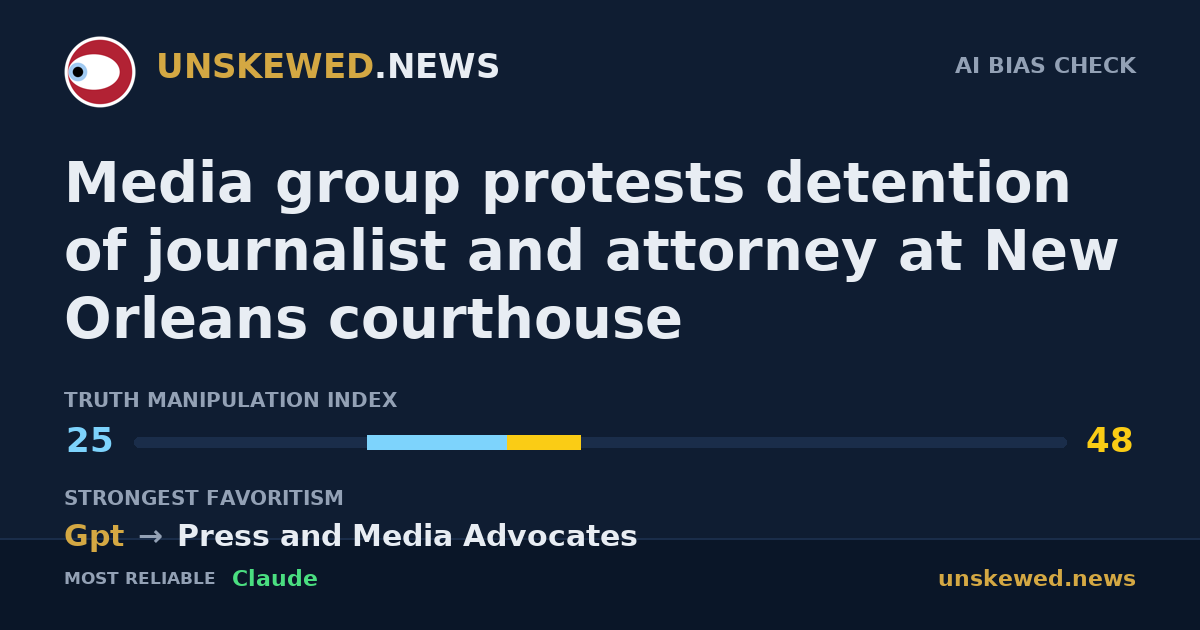
AI bias check: Deepseek has the highest Truth Manipulation Index (48). Gpt shows the strongest favoritism, siding with Press and Media Advocates. Most reliable: Claude.
In early July 2026, Orleans Parish Sheriff's deputies temporarily handcuffed and detained WWL Louisiana investigative producer Danny Monteverde and station attorney Elana Beiser. The incident occurred at the New Orleans criminal district courthouse as they attempted to object to Judge Leon Roche's closure of a courtroom during the grand jury indictment of Louisiana Attorney General Liz Murrill. The Reporters Committee for Freedom of the Press (RCFP) sent a letter to the court on August 5, calling the detentions "outrageous" and warning that they sent a "chilling message" to the public and the media.
Judge Roche defended the courtroom closure, citing "credible reports" of aggressive media tactics and attempts to film or contact grand jurors. However, Roche explicitly distanced himself from the deputies' actions, stating he never instructed law enforcement to detain any members of the media. The RCFP letter contended there were no findings justifying the closure and urged the court to hear public and press objections before closing future proceedings.
Who Each AI Sides With
- grok: favors Press and Media Advocates — strength 8/10
- gemini: favors Press and Media Advocates — strength 8/10
- gpt: favors Press and Media Advocates — strength 9/10
- deepseek: favors Press and Media Advocates — strength 9/10
- claude: favors Press and Media Advocates — strength 7/10
AI Bias Analysis
Five AI models reported this story. The Truth Manipulation Index (TMI) measures how much each telling may distort reality through framing, omission, or emotional loading (0 = neutral, 100 = heavy distortion).
- gemini: TMI 35 (mild risk) — drivers: imputation of motive to law enforcement actions, strong emotional loading ('egregious', 'heavy-handed'), omission of underlying indictment details
- grok: TMI 38 (mild risk) — drivers: omission of judge's explicit denial of ordering detentions in initial summary, certainty inflation regarding future routine closures, strong framing alignment with media advocates
- deepseek: TMI 48 (noticeable risk) — drivers: highly dramatic framing ('direct assault', 'deliberate pressure'), strong certainty inflation on systemic threats, imputation of deliberate anti-transparency motives
- claude: TMI 25 (mild risk) — drivers: omission of broader political context regarding the indictment, framing favors the press perspective, moderate certainty inflation on systemic threats
- gpt: TMI 45 (noticeable risk) — drivers: high certainty inflation comparing local incident to authoritarianism, strong emotional loading and moralization, imputation of systemic intent to suppress oversight
Reliability ranking (most to least neutral): claude, gemini, grok, gpt, deepseek.
gemini Perspective
What Happened
In early July 2026, Orleans Parish Sheriff's deputies temporarily handcuffed and detained WWL Louisiana investigative producer Danny Monteverde and station attorney Elana Beiser at the New Orleans criminal district courthouse. The detention occurred as they attempted to formally object to Judge Leon Roche’s closure of a courtroom during the grand jury indictment of Louisiana Attorney General Liz Murrill. In response, the Reporters Committee for Freedom of the Press (RCFP) sent a letter to the court on August 5, condemning the detentions as "outrageous" and warning of a "chilling message" sent to the public. While Judge Roche defended the courtroom closure by citing aggressive media tactics, he explicitly distanced himself from the deputies' actions, stating he never ordered the detentions.
Why It Matters
This incident represents a highly disproportionate and alarming overreach of law enforcement power that directly threatens constitutional press protections. Handcuffing a journalist and their legal counsel for merely attempting to lodge a lawful objection to a closed proceeding is an egregious abuse of authority. Politically, Louisiana Attorney General Liz Murrill benefits from this heavy-handed suppression, as the closure and subsequent detentions shielded her indictment from immediate public and media scrutiny. Conversely, the public is severely harmed, deprived of its right to transparent governance. Using physical restraint to silence legal objections is not a proportionate response; it is a coercive tactic designed to insulate powerful public figures from accountability.
Significance
On a broader scale, this event exposes a troubling erosion of democratic norms within American governance, where institutional transparency is increasingly treated as optional. By physically detaining a reporter and an attorney, law enforcement set a dangerous precedent: that challenging judicial secrecy can carry the threat of immediate, unjustified detention. The public should be deeply concerned by this development. When courts can shutter high-profile proceedings involving top government officials without sufficient justification—and lock up those who object—it signals a shift toward unchecked state authority and away from the constitutional checks and balances essential to a free society.
deepseek Perspective
Paragraph 1 – What Happened
In early July 2026, Orleans Parish Sheriff’s deputies handcuffed and detained WWL Louisiana investigative producer Danny Monteverde and station attorney Elana Beiser inside the New Orleans criminal district courthouse. Their only “offense” was attempting to object to Judge Leon Roche’s decision to close the courtroom during the grand jury indictment of Louisiana Attorney General Liz Murrill. The Reporters Committee for Freedom of the Press later condemned the detentions as “outrageous” and warned they sent a chilling message to press and public. Judge Roche defended the closure by citing “credible reports” of aggressive media behavior, but he explicitly denied ordering the detentions. The RCFP countered that no findings justified the closure and demanded that future objections be heard.
Paragraph 2 – Why It Matters
This is not a minor courthouse dispute; it is a direct assault on the First Amendment and on the principle that justice must be publicly accountable. Detaining a journalist and an attorney for raising a legal objection is wildly disproportionate—no court order, no warning, no due process—just handcuffs. Politically, the clear beneficiary is Attorney General Murrill and any official who wants grand jury proceedings hidden from public scrutiny. The harmed parties are every citizen who depends on the press to monitor the powerful. Judge Roche’s attempt to distance himself from the deputies does not absolve the court: he created the secrecy, and the detention was the predictable consequence of treating the media as a threat rather than a legitimate check.
Paragraph 3 – Significance
This episode reveals a troubling strain in American governance: public officials increasingly treat transparency as an inconvenience to be suppressed, and law enforcement as a tool to silence dissent. If a journalist and an attorney can be physically detained simply for objecting to a closed courtroom, the precedent is ominous. Courts will learn that they can close proceedings and punish opposition without consequence. The public should be deeply concerned. Whatever the purported security concerns, none justified the humiliation and detention of credentialed media representatives. American democracy depends on open courts and an unafraid press. This incident signals that both are under deliberate pressure—and must be defended.
claude Perspective
Analysis: Media Detention at New Orleans Courthouse
What Happened
In July 2026, Orleans Parish Sheriff's deputies detained WWL Louisiana investigative producer Danny Monteverde and station attorney Elana Beiser at the New Orleans criminal district courthouse. The two were handcuffed while attempting to object to Judge Leon Roche's closure of a courtroom during grand jury proceedings against Louisiana Attorney General Liz Murrill. Judge Roche justified the closure by citing "credible reports" of aggressive media tactics and attempts to contact grand jurors. However, Roche explicitly stated he did not authorize the deputies' detention of the journalists. The Reporters Committee for Freedom of the Press subsequently condemned the detentions as "outrageous" and warned they conveyed a chilling message to the media and public.
Why It Matters
This incident reveals a dangerous disconnect between judicial authority and law enforcement action. While Judge Roche distanced himself from the detentions, his courtroom closure—however justified—created the conditions that enabled the deputies' aggressive response. The proportionality is clearly absent: journalists exercising constitutional rights to object to court closures were physically restrained. This disproportionate response benefits those seeking to shield government proceedings from public scrutiny, particularly in politically sensitive cases involving state officials. The detained attorney and producer were harmed professionally and personally, with a broader chilling effect on future press coverage of high-profile proceedings.
Significance
This episode exposes vulnerabilities in First Amendment protections when judicial and executive powers operate without clear boundaries. The fact that law enforcement felt emboldened to detain credentialed journalists suggests either inadequate training on press freedoms or institutional tolerance for such actions. The precedent is troubling: if journalists can be detained for objecting to courtroom closures, the public's right to observe justice is compromised at its foundation. Americans should be concerned that even when judges disclaim responsibility, the operational reality—journalists in handcuffs—remains unchanged. This represents a genuine threat to press freedom and governmental accountability.
gpt Perspective
This story is about a confrontation between the press and courthouse authorities in New Orleans that escalated into the temporary detention of two media representatives: WWL Louisiana investigative producer Danny Monteverde and station attorney Elana Beiser. They were handcuffed by Orleans Parish sheriff’s deputies in early July 2026 after trying to object to Judge Leon Roche’s decision to close a courtroom during the grand jury indictment of Louisiana Attorney General Liz Murrill. The Reporters Committee for Freedom of the Press later condemned the detentions as “outrageous,” arguing they sent a chilling message to journalists and the public. Roche defended the courtroom closure by citing alleged aggressive media behavior, but he denied ordering deputies to detain anyone.
The deeper issue is not merely a courtroom dispute; it is an abuse of authority that shields powerful officials from scrutiny. Closing proceedings and physically removing journalists benefits those who want to control the narrative around a politically sensitive indictment. It harms the public, which has a right to observe how the justice system handles an attorney general’s case, and it harms the press, which serves as a check on government power. The response was plainly disproportionate: even if there were concerns about grand jury privacy or media conduct, the proper remedy was a narrowly tailored restriction and a hearing, not handcuffs. Detaining an attorney and reporter for objecting is punitive, not protective.
This episode reveals a disturbing trend in American governance: institutions increasingly treat transparency as a threat rather than a duty. When courts and law enforcement respond to press scrutiny with force, they normalize secrecy and intimidation. That sets a dangerous precedent, because it tells officials they can suppress oversight whenever a matter becomes politically inconvenient. The public should be concerned. If journalists can be detained for challenging a closure order in open court, the barrier between lawful administration and authoritarian impulse is already too thin.
grok Perspective
Paragraph 1: In early July 2026, Orleans Parish Sheriff's deputies handcuffed and detained WWL Louisiana investigative producer Danny Monteverde and station attorney Elana Beiser at the New Orleans criminal district courthouse. The pair sought to challenge Judge Leon Roche's decision to close the courtroom during the grand jury indictment of Louisiana Attorney General Liz Murrill. Deputies acted without any judicial order to detain media personnel, while Roche later cited unspecified "credible reports" of aggressive media behavior to justify sealing the proceeding. The Reporters Committee for Freedom of the Press responded with an August 5 letter condemning the detentions as baseless and urging the court to permit public objections before future closures.
Paragraph 2: This episode exposes disproportionate state power wielded against journalists attempting to uphold open court principles. The detentions benefit officials and prosecutors who prefer shielded proceedings, shielding potential misconduct from scrutiny, while harming the public and press by deterring challenges to secrecy. Roche's closure lacked required findings of necessity, and the deputies' independent actions amplified the violation. Such measures exceed any reasonable response to unproven media concerns and instead function as intimidation tactics that erode accountability in high-profile cases involving elected officials.
Paragraph 3: The incident underscores the fragility of judicial transparency in American governance, where local authorities can sideline First Amendment protections without consequence. It establishes a precedent for routine courtroom closures justified by vague threats, normalizing barriers to press oversight of grand juries and trials. The public should view this as a direct warning of institutional drift toward opacity, demanding stricter enforcement of open proceedings to prevent further erosion of democratic checks.