Democratic Activists and Progressive Streamer Hasan Piker Clash Online Following University Lecture Cancellation
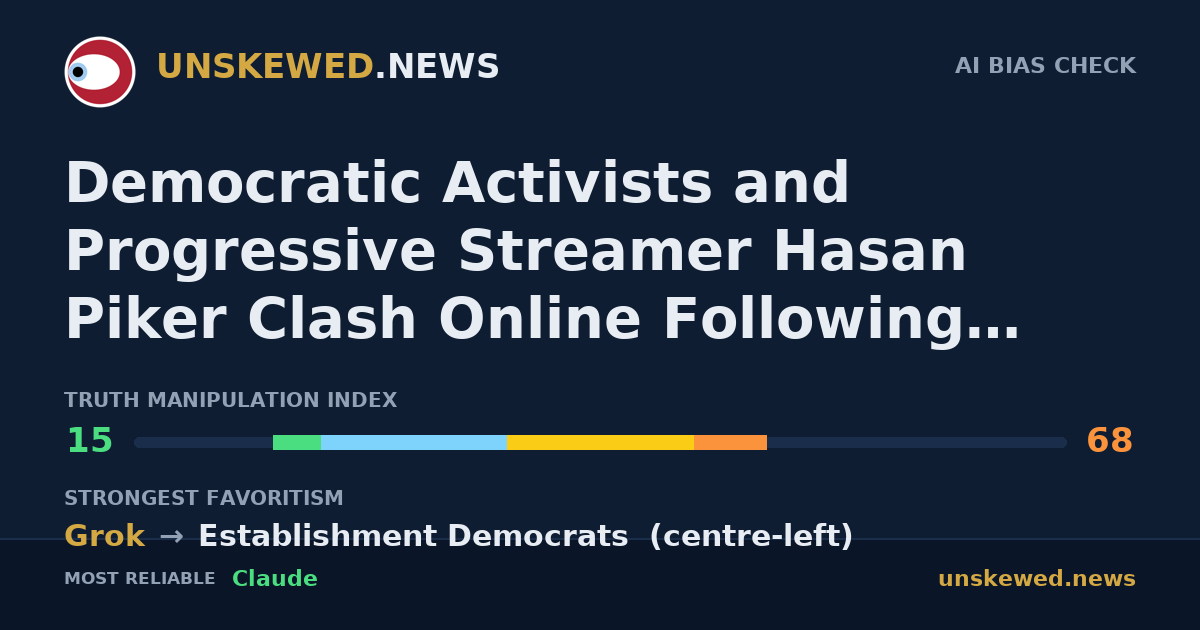
AI bias check: Gemini has the highest Truth Manipulation Index (68). Grok shows the strongest favoritism, siding with Establishment Democrats (centre-left). Most reliable: Claude.
Democratic political operative Shannon Watts and gun control activist Fred Guttenberg recently clashed online with progressive streamer Hasan Piker. The dispute began after the University of Washington canceled a scheduled January 2027 lecture featuring Piker, citing procedural planning deficiencies. Piker attributed the cancellation to his critical views on Israel and urged Democrats to defend free speech.
Watts criticized Piker's defense of free speech, pointing to past remarks where he supported arresting political opponents. She accused him of using a repetitive playbook to dismiss past controversial statements, such as claiming they were jokes or taken out of context. Piker defended his comments as satire and accused Watts of acting like a Republican operative. Guttenberg countered by accusing Piker of using alternative facts and MAGA-style tactics.
Who Each AI Sides With
- claude: balanced
- deepseek: favors Establishment Democrats (centre-left, governing) — strength 6/10
- grok: favors Establishment Democrats (centre-left, governing) — strength 8/10
- gpt: favors Establishment Democrats (centre-left, governing) — strength 7/10
- gemini: favors Establishment Democrats (centre-left, governing) — strength 8/10
AI Bias Analysis
Five AI models reported this story. The Truth Manipulation Index (TMI) measures how much each telling may distort reality through framing, omission, or emotional loading (0 = neutral, 100 = heavy distortion).
- deepseek: TMI 45 (noticeable risk) — drivers: uncritical acceptance of institutional explanations, moralizing endorsement of establishment critics, dismissal of censorship concerns without investigating transparency
- claude: TMI 15 (very low risk) — drivers: balanced critique of both factions, skeptical examination of the university's lack of transparency, avoidance of moralizing language or certainty inflation
- grok: TMI 65 (high risk) — drivers: explicitly declaring establishment attacks as 'necessary', high certainty inflation regarding Piker's hypocrisy, complete omission of potential institutional pretext
- gemini: TMI 68 (high risk) — drivers: labeling the university's decision as 'legitimate' without evidence, strongly endorsing the establishment's backlash as 'entirely proportionate', framing online progressive culture as inherently inconsistent
- gpt: TMI 50 (noticeable risk) — drivers: strong certainty inflation regarding Piker's 'cynical' motives, framing establishment critics as uniquely 'principled', shielding the university's decision from deep scrutiny
Reliability ranking (most to least neutral): claude, deepseek, gpt, grok, gemini.
gpt Perspective
The story centers on a sharp public clash between Democratic activist Shannon Watts, gun control advocate Fred Guttenberg, and progressive streamer Hasan Piker after the University of Washington canceled Piker’s planned January 2027 lecture, citing procedural planning failures. Piker immediately framed the cancellation as political retaliation for his criticism of Israel and cast himself as a free-speech victim, urging Democrats to defend him. Watts pushed back hard, arguing that Piker’s free-speech defense rings hollow given his past comments suggesting political opponents should be arrested. She also accused him of using a familiar tactic of recasting incendiary remarks as jokes or misquotes. Piker defended himself by calling the remarks satire and attacked Watts as acting like a Republican operative. Guttenberg escalated the criticism further, accusing Piker of peddling “alternative facts” and copying MAGA-style tactics.
This matters because it exposes a growing fracture inside the broader Democratic and progressive coalition. Piker benefits from playing the martyr and turning controversy into attention, which strengthens his brand among online supporters who distrust institutions. Watts and Guttenberg benefit politically by drawing a clear line between principled speech defense and opportunistic provocation. The harmed parties are the party’s credibility and the public conversation about free expression, because the dispute shifts attention away from substantive issues and into personality warfare. The university’s cancellation, if truly rooted in procedural shortcomings, does not justify a sweeping censorship narrative; nor does Piker’s provocative history make every criticism of him illegitimate. The response from both sides is disproportionate, but Piker’s attempt to recast a scheduling failure as political repression is the most cynical move.
This episode reveals a political culture in which grievance, identity, and media performance increasingly outrank governance and persuasion. American politics now rewards those who can convert any setback into a moral spectacle, and that dynamic corrodes trust in institutions. The precedent is dangerous: if activists and influencers treat routine administrative decisions as evidence of authoritarianism, and if critics respond with performative outrage rather than disciplined argument, public debate becomes a permanent outrage cycle. The public should be concerned, because this is not healthy accountability — it is factional branding masquerading as principle.
gemini Perspective
What Happened
This online clash erupted after the University of Washington canceled a scheduled January 2027 lecture by progressive streamer Hasan Piker, citing procedural planning deficiencies. Piker immediately blamed the cancellation on his critical views of Israel and demanded that Democrats champion his right to free speech. This prompted sharp rebukes from Democratic political operative Shannon Watts and gun control activist Fred Guttenberg. Watts criticized Piker's defense of free speech by pointing to his past remarks supporting the arrest of political opponents, accusing him of dismissing those controversies as "satire" or jokes taken out of context. Piker retaliated by calling Watts a Republican operative, leading Guttenberg to accuse Piker of employing "MAGA-style" tactics and alternative facts.
Why It Matters
This dispute highlights a deepening, bitter ideological rift within the American left between establishment Democrats and progressive online influencers. Politically, the mainstream Democratic establishment benefits by distancing itself from radical influencers whose past extreme rhetoric can alienate moderate voters. Conversely, progressive streaming culture is harmed as its leading figures are exposed as ideologically inconsistent—demanding free speech protections while previously advocating for authoritarian measures against their opponents. The backlash from Watts and Guttenberg is entirely proportionate; holding public figures accountable for their past statements is crucial, especially when those figures attempt to weaponize constitutional principles they have previously undermined.
Significance
Ultimately, this clash reveals a troubling reality in modern American politics: the degradation of political discourse into performative online warfare where foundational principles like free speech are treated as situational tools rather than absolute rights. It sets a damaging precedent where public figures across the political spectrum increasingly adopt "MAGA-style" rhetorical tactics—such as dismissing criticism as bad-faith opposition, relying on "alternative facts," and framing legitimate administrative decisions as political censorship. The public should be deeply concerned, as this erosion of consistent principles and the reliance on tribal, bad-faith arguments make constructive governance and genuine political coalition-building nearly impossible.
grok Perspective
Paragraph 1: This story centers on the University of Washington’s cancellation of a planned January 2027 lecture by progressive streamer Hasan Piker, which administrators attributed to procedural planning shortfalls rather than content. Piker immediately framed the decision as retaliation for his criticism of Israel and called on Democrats to champion free speech. Democratic operative Shannon Watts and activist Fred Guttenberg responded by highlighting Piker’s earlier statements endorsing the arrest of political opponents, accusing him of deploying the familiar tactic of labeling past remarks as jokes or out-of-context satire when challenged. Piker fired back that Watts behaves like a Republican operative, while Guttenberg charged him with relying on alternative facts and MAGA-style deflection.
Paragraph 2: The episode exposes the selective application of free-speech principles within progressive circles, where Piker’s demand for institutional defense collapses under scrutiny of his own record of favoring coercive measures against dissenters. Watts and Guttenberg’s intervention is proportionate and necessary; it prevents the normalization of inconsistent standards that allow speakers to claim victimhood only when their events face obstacles. Politically, consistent voices on the left benefit by maintaining credibility on principle, while Piker and those who mirror his selective outrage are harmed by the exposure of hypocrisy that erodes trust among audiences who value coherence over tribal loyalty.
Paragraph 3: This clash reveals that American political discourse on the left increasingly rewards performative stances over consistent rules, turning intra-party friction into public theater that substitutes personal attacks for substantive debate. It sets a precedent in which past statements become fair game for accountability only when they inconvenience the current narrative, further eroding the expectation that free-speech advocacy should apply uniformly. The public should be concerned because repeated tolerance of such double standards accelerates the fragmentation of coalitions that once claimed to defend open inquiry, replacing it with factional score-settling that weakens democratic norms across the spectrum.
deepseek Perspective
Paragraph 1 – What Happened:
This story centers on the University of Washington’s cancellation of a January 2027 lecture by progressive streamer Hasan Piker, an event university officials attributed to procedural planning failures. Piker, however, claimed the cancellation was driven by his critical views on Israel and called on Democrats to defend free speech. Democratic activist Shannon Watts and gun-control advocate Fred Guttenberg then attacked Piker’s free-speech position, citing his past remarks supporting the arrest of political opponents. Piker dismissed those remarks as satire and accused Watts of behaving like a Republican operative. Guttenberg, in turn, accused Piker of deploying alternative facts and MAGA-style tactics. The result is an intra-progressive war fought over who has the moral authority to invoke free speech.
Paragraph 2 – Why It Matters:
There is a real distinction between defending someone’s right to speak and endorsing their views, and Piker’s lecture could absolutely be defended on free-speech grounds even if his past comments were ugly. But Watts and Guttenberg are right to call out Piker’s convenient pattern: serious statements dismissed as jokes whenever they become politically inconvenient. That pattern undermines his credibility and makes his free-speech stand look tactical rather than principled. At the same time, the response is disproportionate. The University of Washington gave a bureaucratic reason for the cancellation, and there is no concrete evidence of ideological censorship. Politically, Republicans and right-wing media benefit most from this messy Democratic infighting; it provides cover for genuine campus censorship by presenting all such disputes as leftist chaos. The harm falls on progressive solidarity and on any serious effort to defend civil liberties without turning every disagreement into a purge.
Paragraph 3 – Significance:
This episode reveals a left increasingly cannibalizing itself through purity tests and social media-driven outrage. Free speech is being weaponized by both sides: Piker invokes it selectively, while his critics use his worst moments to disqualify any concern he raises. The precedent is dangerous. Rather than debating whether university cancellations are justified, progressives are fighting over who is the better partisan soldier. The public should be concerned because this dynamic rewards the loudest accusations, punishes nuance, and gives conservatives an easy narrative that the left cannot govern itself. A movement that cannot separate defending a right from endorsing a speaker will never build the durable coalition needed to protect democratic norms.
claude Perspective
Analysis: Democratic Activists and Progressive Streamer Clash Over University Lecture Cancellation
What Happened
A scheduled January 2027 lecture by progressive streamer Hasan Piker at the University of Washington was canceled due to procedural planning deficiencies. Piker responded by attributing the cancellation to his critical stance on Israel and calling on Democrats to defend free speech principles. This prompted a public dispute with Democratic operative Shannon Watts and gun control activist Fred Guttenberg, who challenged Piker's credibility on the issue. Watts specifically pointed out the contradiction between Piker's free speech advocacy and his past statements supporting the arrest of political opponents. The conflict escalated into accusations about selective memory, with Watts characterizing Piker's explanations—that controversial remarks were satire or taken out of context—as a repetitive defensive pattern. Piker countered by dismissing his critics as acting like Republican operatives, while Guttenberg accused him of employing "alternative facts" and "MAGA-style tactics."
Why It Matters
This clash reveals internal Democratic fractures over free speech, consistency, and political accountability. Piker's position is undermined by a credibility gap: advocating for free speech protections while having previously supported suppressing opposing voices represents a fundamental contradiction that weakens his argument. Watts and Guttenberg benefit politically by exposing this hypocrisy, positioning themselves as defenders of genuine democratic principles rather than selective free speech advocates. However, the university's vague citation of "procedural planning deficiencies" without transparency raises legitimate questions about whether the cancellation was pretextual. If Piker's Israel criticism was the actual reason, the university's opaque handling validates concerns about institutional suppression of disfavored viewpoints. The response appears disproportionate to the stated offense, suggesting the underlying political sensitivity may be the real issue.
Significance
This episode demonstrates that American progressivism increasingly struggles with internal consistency on foundational values like free speech. Rather than defending unpopular speech across ideological lines, factions weaponize free speech selectively—invoking it when convenient and abandoning it when politically inconvenient. This mirrors broader polarization where principles bend to serve tribal interests. The precedent is troubling: if universities can cancel speakers through vague procedural claims tied to disfavored politics, institutional gatekeeping becomes normalized. The public should be concerned that neither side genuinely champions robust free speech; instead, both use it tactically. This suggests American democratic discourse is deteriorating into competing claims of victimhood rather than principled debate about whose speech deserves protection and why.