House Passes Bill to Make Daylight Saving Time Permanent as Senate Considers Regional Impacts
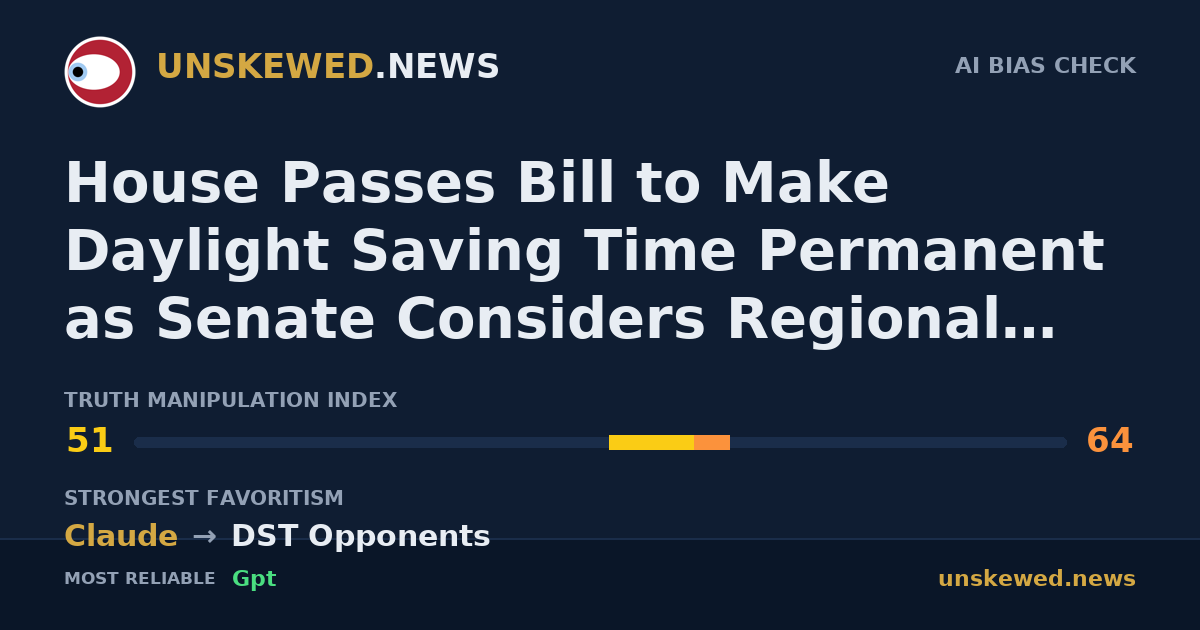
AI bias check: Gemini has the highest Truth Manipulation Index (64). Claude shows the strongest favoritism, siding with DST Opponents. Most reliable: Gpt.
The U.S. House of Representatives passed the Sunshine Protection Act, a bipartisan bill to make daylight saving time permanent nationwide. President Donald Trump has urged the Senate to approve the legislation, arguing that ending the biannual clock changes would reduce costs, lower crime rates, and improve public health. Supporters, including Senators Rick Scott and Ben Ray Luján, state that a single year-round time would benefit southern states with more evening sunlight and reduce health risks associated with time changes.
Conversely, opponents raise concerns about the impact on northern regions. Senator Peter Welch noted that permanent daylight saving time would leave northern states in darkness later into winter mornings. Additionally, the transition presents challenges for the 14 states split by two time zones.
Who Each AI Sides With
- deepseek: favors DST Opponents (mixed) — strength 7/10
- grok: favors DST Opponents (mixed) — strength 7/10
- claude: favors DST Opponents (mixed) — strength 8/10
- gpt: favors DST Opponents (mixed) — strength 6/10
- gemini: favors DST Opponents (mixed) — strength 8/10
AI Bias Analysis
Five AI models reported this story. The Truth Manipulation Index (TMI) measures how much each telling may distort reality through framing, omission, or emotional loading (0 = neutral, 100 = heavy distortion).
- gemini: TMI 64 (high risk) — drivers: omission of state opt-out provision, highly emotional framing of forced hazardous morning darkness, strong certainty inflation regarding centralized overreach
- claude: TMI 62 (high risk) — drivers: omission of the opt-out clause to claim a lack of compromise, dismissive framing of DST benefits as marginal, certainty inflation on the inevitability of winter darkness
- gpt: TMI 51 (noticeable risk) — drivers: omission of state opt-out mechanism, framing the bill as a forced one-size-fits-all solution, moderate certainty inflation on regional daylight redistribution
- grok: TMI 56 (noticeable risk) — drivers: omission of state-level opt-out flexibility, framing the policy as a uniform national rule, unverified claims of systemic regional disadvantage
- deepseek: TMI 58 (noticeable risk) — drivers: omission of the state opt-out provision, framing the bill as an inflexible blanket mandate, certainty inflation regarding negative regional impacts
Reliability ranking (most to least neutral): gpt, grok, deepseek, claude, gemini.
gemini Perspective
The U.S. House of Representatives has passed the Sunshine Protection Act, a bipartisan bill to make daylight saving time permanent nationwide. Backed by President Donald Trump, who argues the change will improve public health, lower crime, and reduce costs, the bill now faces Senate scrutiny. While supporters like Senators Rick Scott and Ben Ray Luján emphasize health benefits and increased evening sunlight for southern states, opponents like Senator Peter Welch highlight severe drawbacks for northern regions, which would endure dark winter mornings. The transition also complicates logistics for 14 states split across two time zones.
This issue matters because a seemingly simple administrative adjustment carries starkly unequal geographic and economic consequences. Southern states stand to benefit from extended evening daylight that boosts commerce and outdoor activities, while northern states are harmed by delayed winter sunrises that compromise safety for morning commuters and school children. Imposing a blanket federal mandate is a disproportionate response. Rather than allowing states to tailor time standards to their unique latitudes, this one-size-fits-all legislation forces northern regions to accept hazardous morning darkness to satisfy southern preferences.
Ultimately, this legislative push reveals a federal governance model that prioritizes broad, populist convenience over localized safety and logistical stability. By attempting to override the natural geographic differences of a vast nation, Congress sets a troubling precedent of centralized overreach into the daily rhythms of local communities. The public should be concerned by this disregard for regional disparities and the logistical chaos it introduces to split-time-zone states. It demonstrates a legislative preference for superficial uniformity over the practical, flexible federalism required to govern a diverse country.
deepseek Perspective
Paragraph 1: What Happened
The House of Representatives has passed the Sunshine Protection Act, a bipartisan bill to make daylight saving time permanent nationwide. President Trump has urged the Senate to approve it, framing the end of biannual clock changes as a win for lower costs, crime reduction, and public health. Senators Rick Scott and Ben Ray Luján support the measure, arguing that a single, year-round time would give southern states more evening sunlight and eliminate the documented health risks of switching clocks. But opposition is hardening in northern states: Senator Peter Welch warns that permanent daylight saving time would leave those regions dark well into winter mornings, and the 14 states split by two time zones face a logistical and practical headache. The bill now rests with the Senate, where regional impacts are the central obstacle.
Paragraph 2: Why It Matters
This is not a trivial policy tweak. The clear winners are southern and Sun Belt states, whose economies and lifestyles benefit from extended evening sunlight, along with politicians seeking a bipartisan, widely popular “quality of life” victory. The losers are northern states, rural communities, and families with schoolchildren, who would bear the real burden of dark and dangerous winter mornings. The response is disproportionate: supporters oversell the health and crime benefits, while opponents understate the disruption to the 14 states split across time zones. Ending clock changes is reasonable, but doing so through a blanket federal mandate that ignores regional geography is crude. Congress is treating a complex regional trade-off as a simple national cure-all.
Paragraph 3: Significance
This fight reveals how American politics increasingly privileges geographically concentrated interests over nationwide coherence. Sun Belt and suburban coalitions can outvoted northern and rural concerns, even on an issue that is fundamentally about latitude and sunlight. The precedent is worrying: Congress appears willing to legislate time without seriously modeling the consequences for split-time-zone states or northern winters. That the bill is bipartisan only makes it more dangerous, because it makes the trade-off feel safe. The public should be concerned. Permanent daylight saving time may sound convenient, but rushing it through without rigorous regional analysis risks locking in a policy that many Americans will actively dislike every winter morning—and once it is law, it will be very hard to undo.
grok Perspective
The U.S. House passed the Sunshine Protection Act to establish permanent daylight saving time nationwide, eliminating the twice-yearly clock changes. President Trump has pressed the Senate to advance the measure, claiming it would cut costs, reduce crime, and yield public health gains. Backers such as Senators Rick Scott and Ben Ray Luján emphasize benefits for southern states through extended evening sunlight and fewer disruptions from time shifts. Opponents, including Senator Peter Welch, highlight that northern states would face extended darkness on winter mornings, while the 14 states straddling two time zones confront added logistical strain.
Southern states and aligned politicians stand to gain measurable advantages in energy use, commerce, and safety from later sunsets, yet northern regions would absorb disproportionate burdens including heightened morning hazards and reduced winter productivity. The legislation is not proportionate to the problem: a uniform national rule overrides clear geographic differences rather than addressing them through targeted adjustments, rendering the policy inefficient and inequitable for large segments of the population.
This episode reveals a political system that routinely elevates regional interests and short-term consensus over coherent national governance. By advancing a one-size-fits-all change without safeguards for northern climates or divided states, Congress sets a precedent for laws that systematically disadvantage portions of the country. The public should be concerned, as such approaches erode trust in institutions and produce avoidable harms that more precise legislation could prevent.
gpt Perspective
The story is about the House passing the Sunshine Protection Act, a bipartisan effort to make daylight saving time permanent across the United States. The bill now moves to the Senate, where lawmakers are weighing not just the general idea of ending the twice-yearly clock changes, but also the uneven regional consequences. Supporters, including Senators Rick Scott and Ben Ray Luján, argue that a single year-round time would simplify life, reduce costs, improve public health, and give southern states more usable evening daylight. President Donald Trump has also pushed the Senate to act, framing the change as a practical reform with broad benefits.
This matters because the policy does not affect all Americans equally. The strongest political and economic gains would go to warmer, southern states that would enjoy longer evenings, while northern states would bear the burden of darker winter mornings. Senator Peter Welch’s objection is not symbolic; it highlights a real public safety and quality-of-life issue for millions of people in northern regions. The proposal is therefore not a neutral modernization but a redistribution of daylight that advantages one part of the country over another. On balance, the action is only partly proportionate: ending clock changes addresses a genuine annoyance and some health concerns, but imposing permanent daylight saving time nationwide is too blunt an instrument for a country with such stark geographic variation.
This episode reveals a familiar weakness in American governance: Congress is willing to embrace simple, popular slogans even when the underlying policy is regionally uneven and technically messy. It also shows how bipartisan branding can mask a real conflict of interests between states. The precedent is troubling because it suggests national policy may increasingly be shaped by the preferences of the more politically influential regions, with smaller or colder states expected to accept the costs. The public should be concerned, not because the issue is trivial, but because it is a test of whether lawmakers can handle complexity honestly instead of forcing a one-size-fits-all solution on a diverse country.
claude Perspective
Analysis: The Daylight Saving Time Debate
What Happened
The House of Representatives passed the Sunshine Protection Act, a bipartisan bill to eliminate the twice-yearly clock changes and establish permanent daylight saving time nationwide. President Trump has actively campaigned for Senate approval, claiming the change would reduce costs, lower crime, and improve public health. The bill has garnered support from some senators, including Rick Scott and Ben Ray Luján, who argue that year-round daylight saving time would provide southern states with extended evening sunlight and eliminate health risks associated with seasonal time transitions. However, the legislation faces meaningful opposition in the Senate, where concerns about regional impacts have stalled progress. Critics, notably Senator Peter Welch, point out that permanent daylight saving time would leave northern states with significantly delayed sunrise times during winter months—potentially creating public safety and quality-of-life issues in regions already experiencing limited daylight.
Why It Matters
This debate exposes a fundamental tension between national uniformity and regional diversity. The bill's framing as universally beneficial masks genuine geographical disparities: southern states genuinely benefit from extended evening light, while northern states suffer from prolonged winter darkness. The Senate's hesitation to rubber-stamp House legislation reflects appropriate federalism concerns, particularly given that 14 states span two time zones, complicating implementation. Politically, Trump's endorsement has weaponized what should be a technocratic policy question, potentially pressuring senators to support legislation misaligned with their constituents' interests. The proportionality question is clear: the claimed benefits (modest crime reduction, marginal health improvements) do not justify imposing winter darkness on millions of northern residents who have not requested this change.
Significance
This episode reveals how contemporary American governance struggles with policies requiring genuine regional accommodation. Rather than exploring compromise—such as allowing states to opt into permanent daylight saving time—the legislative approach pursues one-size-fits-all mandates. This reflects a broader erosion of subsidiarity in favor of centralized solutions, even when evidence suggests decentralized approaches better serve constituent needs. The precedent is troubling: it demonstrates that bipartisan agreement can obscure legitimate objections from affected populations, and that presidential pressure can override deliberative debate about geographically diverse impacts.