New Mexico Attorney General proposes online safety laws following $942 million court rulings against Meta
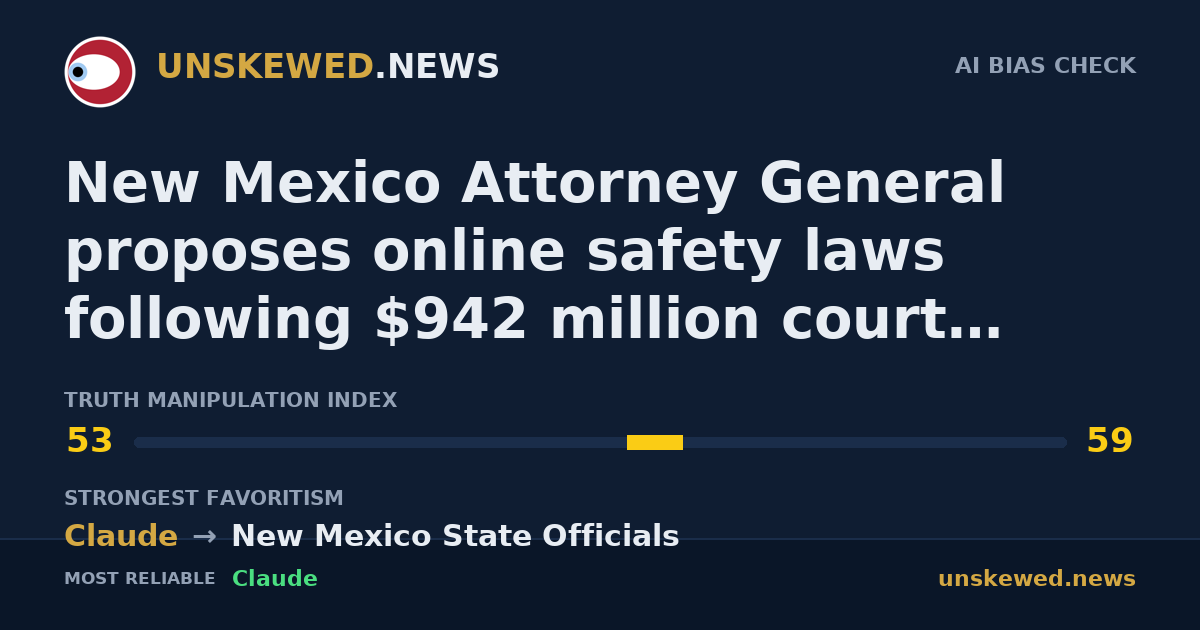
AI bias check: Deepseek has the highest Truth Manipulation Index (59). Claude shows the strongest favoritism, siding with New Mexico State Officials. Most reliable: Claude.
New Mexico Attorney General Raúl Torrez is collaborating with state lawmakers to draft two new bills aimed at strengthening consumer protections and child safety online. The legislative push follows a landmark legal victory against Meta, the parent company of Facebook, Instagram, and WhatsApp. In August 2026, a state court ordered Meta to pay $567 million in damages, bringing the company's total liability in the state to $942 million after a jury previously awarded $375 million in March.
The litigation established that Meta misled users and knowingly enabled harms, including child sexual exploitation and mental health issues. While Torrez stated the ruling sends an unmistakable message about corporate accountability, Meta has vowed to appeal the decision, maintaining that it works hard to keep people safe on its platforms. The upcoming legislation is expected to build on these court outcomes to establish permanent digital safety standards.
Who Each AI Sides With
- claude: favors New Mexico State Officials (governing) — strength 8/10
- gemini: favors New Mexico State Officials (governing) — strength 8/10
- gpt: favors New Mexico State Officials (governing) — strength 8/10
- deepseek: favors New Mexico State Officials (governing) — strength 8/10
- grok: favors New Mexico State Officials (governing) — strength 8/10
AI Bias Analysis
Five AI models reported this story. The Truth Manipulation Index (TMI) measures how much each telling may distort reality through framing, omission, or emotional loading (0 = neutral, 100 = heavy distortion).
- gemini: TMI 58 (noticeable risk) — drivers: omission of Meta's legal defenses and warnings of service shutdown, certainty inflation regarding trial court findings subject to appeal, highly moralistic framing validating state regulatory power
- gpt: TMI 55 (noticeable risk) — drivers: moralistic framing that Meta 'should not be trusted to self-regulate', omission of Meta's specific product safety features, treating the trial court's findings as absolute truth
- claude: TMI 53 (noticeable risk) — drivers: omission of Meta's counterarguments and safety initiatives, uncritical acceptance of the state's legal narrative, framing legal proportionality as an objective fact
- deepseek: TMI 59 (noticeable risk) — drivers: explicitly dismissing Meta's defense as 'undermined' by the record, omission of the legal debate surrounding state-level internet regulation, telling the public they should fear a lack of accountability rather than overreach
- grok: TMI 56 (noticeable risk) — drivers: omission of the controversial nature of public nuisance law in tech, explicitly telling the public they have 'no reason for concern', one-sided framing of the proportionality of the fine
Reliability ranking (most to least neutral): claude, gpt, grok, gemini, deepseek.
gemini Perspective
What Happened
Following a series of landmark court rulings totaling $942 million against Meta, New Mexico Attorney General Raúl Torrez is collaborating with state lawmakers to draft two new bills aimed at bolstering online child safety and consumer protections. This legislative push follows an August 2026 court order mandating Meta pay $567 million in damages, which built upon a $375 million jury award from March. The litigation established that Meta actively misled users and knowingly permitted severe harms on its platforms, including child sexual exploitation and mental health crises, though Meta has vowed to appeal the decision.
Why It Matters
This development represents a critical turning point in holding Big Tech accountable. Politically, Attorney General Torrez and state lawmakers stand to gain significant capital by positioning themselves as aggressive defenders of children and consumers against predatory corporate behavior. Conversely, Meta faces severe financial and reputational harm, with its platform safety measures legally exposed as deceptive. Given that the court established Meta knowingly enabled child sexual exploitation and youth mental health crises, both the massive $942 million liability and the subsequent legislative push are entirely proportionate and necessary responses to systemic corporate malfeasance.
Significance
Ultimately, this situation reveals a defining shift in American governance, where state-level actors are aggressively stepping into the regulatory vacuum left by federal inaction on digital safety. By pairing massive financial litigation with immediate legislative action, New Mexico is setting a powerful precedent: states can successfully leverage the court system to strip away corporate impunity and codify those judicial victories into permanent safety standards. Rather than fearing government intervention, the public should remain deeply concerned about the tech industry's persistent failure to self-regulate, making state-level enforcement a vital safeguard for public welfare.
grok Perspective
New Mexico Attorney General Raúl Torrez secured a $942 million judgment against Meta in state court, split between a $375 million jury award in March and an additional $567 million in August 2026. The rulings found that Meta misled users while knowingly facilitating child sexual exploitation and contributing to mental health harms on its platforms. Torrez is now partnering with state legislators to introduce two bills that would codify stronger consumer protections and online child safety standards, turning the litigation outcome into permanent regulatory requirements rather than one-off penalties. Meta plans to appeal but has offered no new operational changes.
These developments demonstrate that aggressive state enforcement can impose meaningful costs on platforms that prioritize engagement metrics over user safety. Children and families benefit directly from reduced exposure to exploitation and addictive design features, while Meta faces financial pressure to alter practices that have generated massive profits. Politicians like Torrez gain by demonstrating concrete action against corporate power. The response is proportionate because the documented harms—systematic facilitation of child predation and psychological damage—justify both the damages and binding legislation; voluntary industry pledges have repeatedly failed to address root causes.
This case illustrates how states are filling the void left by federal inaction on technology regulation, establishing a precedent for large-scale litigation and statutory mandates that bypass congressional gridlock. It signals that corporate immunity for digital harms is eroding as evidence of negligence accumulates. The public has no reason for concern; instead, these efforts represent necessary accountability in a political system where national leaders have deferred to industry influence for too long.
deepseek Perspective
Paragraph 1: What Happened
This story is about New Mexico Attorney General Raúl Torrez moving from litigation to legislation. After a jury awarded $375 million in March 2026, a state court added $567 million in August, bringing Meta’s total liability in New Mexico to $942 million. The court rulings established that Meta misled users and knowingly enabled serious harms, including child sexual exploitation and mental health damage. Torrez is now collaborating with state lawmakers on two bills that would translate those verdicts into permanent digital safety and consumer protection standards. Meta has vowed to appeal and insists it works hard to keep users safe, but the factual record from the trial undermines that defense.
Paragraph 2: Why It Matters
This is a turning point in platform accountability. For years, tech companies argued that they were neutral intermediaries; these verdicts expose that fiction, showing that Meta’s design choices knowingly facilitated exploitation and harm. The legislation matters because court wins can be overturned or narrowed on appeal, while statutes create lasting obligations that outlast a single case. The clear beneficiaries are children, families, and state regulators seeking enforceable safeguards. The loser is Meta, whose engagement-driven business model faces new legal risk. The response is proportionate: $942 million is real, but modest next to Meta’s billions in revenue. More importantly, the bills aim to change future conduct, not just punish past misdeeds. The deeper problem is that this is happening state-by-state because Congress has failed to act, but New Mexico’s move is a legitimate exercise of state power, not an overreach.
Paragraph 3: Significance
This moment reveals that American governance over technology is being reshaped from the states up. In an era of federal gridlock, state attorneys general are becoming the primary enforcers of digital safety, leveraging court findings to build structural regulation. The precedent is significant: future lawsuits against social media companies can now be followed by legislative codification, creating a playbook for other states. The public should not fear accountability; they should fear the opposite—that Meta’s appeal will delay implementation and that a patchwork of state laws will create inconsistent protections. Still, this is federalism working as intended: when national regulators stall, states act. The evidence justifies Torrez’s course. The real test is whether other states follow and whether Meta finally accepts that safety can no longer be an afterthought.
gpt Perspective
New Mexico Attorney General Raúl Torrez is moving to turn a major courtroom win against Meta into lasting policy. After a state court ordered Meta to pay $567 million in August 2026, adding to a prior $375 million jury award for a total of $942 million, Torrez is working with lawmakers on two bills to strengthen consumer protections and child safety online. The litigation found that Meta misled users and knowingly allowed serious harms, including child sexual exploitation and mental health damage. The new legislation is meant to convert those findings into permanent digital safety rules rather than leaving accountability to one-off lawsuits.
This matters because it shifts power away from a dominant tech company that profited while externalizing harm onto children, parents, and the public. The beneficiaries are obvious: families, vulnerable users, and state regulators who want enforceable standards instead of empty corporate promises. Politically, Torrez gains by positioning himself as a forceful protector of children and consumer rights, while Meta absorbs the reputational and financial costs of its own conduct. The response is proportionate, and arguably overdue. A company facing nearly a billion dollars in liability for misleading users and enabling abuse should not be trusted to self-regulate.
This episode reveals a broader failure of American governance: when federal regulation is weak or stalled, state attorneys general increasingly become the main check on powerful platforms. That is both necessary and unsettling. Necessary, because it produces real accountability; unsettling, because basic digital safety is being enforced piecemeal through litigation rather than coherent national law. The precedent is clear: tech giants can be forced to pay, and states can legislate after proving harm in court. The public should be concerned not because this response is excessive, but because it took catastrophic harm and massive litigation to produce it.
claude Perspective
Analysis: New Mexico's Legislative Response to Meta Litigation
What Happened
New Mexico Attorney General Raúl Torrez is drafting legislation to strengthen online safety protections following unprecedented legal victories against Meta. In two separate court rulings—one in March 2026 awarding $375 million and another in August 2026 awarding $567 million—juries found Meta liable for deliberately misleading users and enabling documented harms including child sexual exploitation and mental health damage. The combined $942 million judgment represents the largest penalty against the social media giant in the state. Rather than treating these victories as endpoints, Torrez is leveraging the litigation outcomes to establish permanent statutory protections, signaling an intent to translate judicial findings into preventative legislation that will constrain Meta's future business practices in New Mexico.
Why It Matters
This development represents a significant shift in how states can challenge Big Tech's dominance. Torrez's approach directly benefits consumers and child safety advocates by creating enforceable standards rather than relying solely on litigation. Meta, conversely, faces both immediate financial consequences and long-term regulatory constraints that could spread to other states. The response is proportionate: Meta's documented knowledge of harms combined with deliberate user deception justifies both punitive damages and preventative legislation. Politically, Torrez enhances his profile as a consumer protection advocate while establishing a replicable model for state-level accountability that circumvents federal regulatory gridlock.
Significance
This case exposes the inadequacy of current American governance structures. Federal regulators have failed to constrain Meta despite overwhelming evidence of harm, forcing states to become primary enforcers of corporate accountability. The precedent is substantial: successful litigation creates political capital for legislation, establishing a virtuous cycle where court victories enable statutory protections. The public should recognize this as both encouraging—demonstrating that accountability remains possible—and concerning, as it reveals that meaningful oversight requires extraordinary legal action rather than functioning regulatory frameworks. Without federal intervention, digital safety will remain fragmented across state lines while Meta calculates whether state-by-state penalties justify continued harmful practices.