US Navy veterans and experts raise concerns over conditions on USS Abraham Lincoln after 250 days at sea
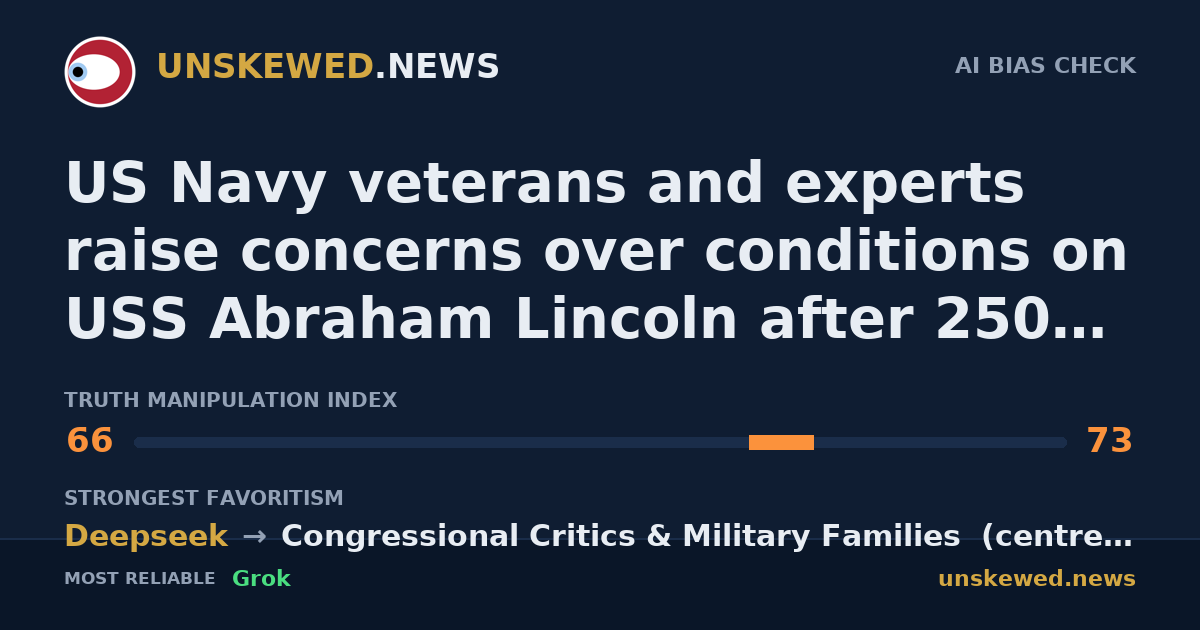
AI bias check: Deepseek has the highest Truth Manipulation Index (73). It also shows the strongest favoritism, siding with Congressional Critics & Military Families (centre-left). Most reliable: Grok.
The San Diego-based aircraft carrier USS Abraham Lincoln has spent over 250 consecutive days at sea without a significant port visit. Originally deployed on November 21 to the Pacific, the carrier was redirected to the Middle East to support U.S. operations. Military health experts, veterans, and families have raised concerns over the crew's mental health and living conditions, citing reports of water and food shortages, moldy showers, broken toilets, and multiple attempts by sailors to jump overboard.
In response to these concerns, U.S. Representative Mike Levin called for a full investigation into the ship's conditions. Navy leadership, including Acting Navy Secretary Hung Cao, met with families to address the situation, stating that the carrier would eventually be relieved by the USS Theodore Roosevelt. Meanwhile, President Donald Trump downplayed the concerns, stating that the deployment was not long enough.
Who Each AI Sides With
- deepseek: favors Congressional Critics & Military Families (centre-left, mixed) — strength 9/10
- claude: favors Congressional Critics & Military Families (centre-left, mixed) — strength 8/10
- grok: favors Congressional Critics & Military Families (centre-left, mixed) — strength 8/10
- gpt: favors Congressional Critics & Military Families (centre-left, mixed) — strength 8/10
- gemini: favors Congressional Critics & Military Families (centre-left, mixed) — strength 8/10
AI Bias Analysis
Five AI models reported this story. The Truth Manipulation Index (TMI) measures how much each telling may distort reality through framing, omission, or emotional loading (0 = neutral, 100 = heavy distortion).
- gemini: TMI 68 (high risk) — drivers: omission of Navy's official denial of suicide attempts, certainty inflation on unverified crew jump attempts, framing of executive actions as systemic rot
- grok: TMI 66 (high risk) — drivers: omission of Navy's official denial of suicide attempts, certainty inflation on unverified crew jump attempts, framing of executive actions as serving political optics
- gpt: TMI 68 (high risk) — drivers: omission of Navy's official denial of suicide attempts, certainty inflation on unverified crew jump attempts, emotional loading regarding Trump's comments
- claude: TMI 67 (high risk) — drivers: omission of Navy's official denial of suicide attempts, certainty inflation on unverified crew jump attempts, framing of executive actions as undermining accountability
- deepseek: TMI 73 (high risk) — drivers: omission of Navy's official denial of suicide attempts, certainty inflation on unverified crew jump attempts, highly emotional loading and partisan framing
Reliability ranking (most to least neutral): grok, claude, gpt, gemini, deepseek.
deepseek Perspective
Paragraph 1 – What Happened:
The USS Abraham Lincoln has been at sea for more than 250 consecutive days, a deployment extended from the Pacific to the Middle East with no meaningful port visit. Sailors have endured water and food shortages, moldy showers, broken toilets, and a documented mental health crisis severe enough that multiple crew members attempted to jump overboard. In response, Representative Mike Levin has demanded a formal investigation. Navy leaders, including Acting Secretary Hung Cao, have met with families and promised eventual relief by the USS Theodore Roosevelt. President Donald Trump, however, publicly dismissed the severity, claiming the deployment was not long enough to warrant concern.
Paragraph 2 – Why It Matters:
This is not a logistical inconvenience; it is a preventable humanitarian failure within the U.S. military. The political benefit here flows to the Trump administration, which can claim operational toughness and avoid scrutiny by minimizing the crisis. The people harmed are the sailors and their families, who are treated as expendable instruments of posture rather than human beings entitled to basic safety. An investigation and a promised relief are necessary, but they are not proportionate to the gravity of the situation. A deployment that drives service members to suicide attempts demands immediate intervention, not dismissive commentary from the commander in chief. Downplaying the crisis actively worsens the problem by signaling that mental health and living conditions are secondary to political narrative.
Paragraph 3 – Significance:
This episode reveals a disturbing pattern in American governance: the executive branch prioritizes image over institutional duty and treats military personnel as props for strength projection. When a president publicly contradicts documented suffering, it sends a message to the entire chain of command that morale and safety can be sacrificed without consequence. The precedent is dangerous—if repeated, it normalizes abusive deployments and discourages service members from reporting hazards. The public should be deeply concerned. A nation that cannot protect its own sailors at sea is not projecting strength; it is exposing weakness, and the political dismissal of this crisis only deepens the institutional rot.
claude Perspective
Analysis: USS Abraham Lincoln Deployment Crisis
What Happened
The USS Abraham Lincoln, a San Diego-based aircraft carrier, has been at sea for over 250 consecutive days without significant port relief, originally deployed in November to the Pacific before being redirected to Middle East operations. During this extended deployment, the crew has faced documented deteriorating conditions including water and food shortages, mold in shower facilities, broken sanitation systems, and multiple suicide attempts by sailors. These conditions prompted military health experts, veterans, and crew families to voice serious concerns about crew welfare and mental health. In response, U.S. Representative Mike Levin called for a full investigation, and Navy leadership met with families to discuss relief efforts, with the USS Theodore Roosevelt expected to provide eventual replacement. However, President Trump dismissed these concerns as unfounded, claiming the deployment duration was insufficient.
Why It Matters
This situation reveals a stark disconnect between those responsible for sailor welfare and political leadership. The documented conditions—water shortages, sanitation failures, and suicide attempts—constitute a genuine crisis requiring immediate remediation, not dismissal. Navy leadership's measured response acknowledges the problem's legitimacy, but Trump's downplaying of these concerns undermines accountability and sends a dangerous message that crew welfare is expendable for operational continuity. The political benefit of maintaining deployment posture appears to outweigh the documented harm to service members. A proportionate response would include immediate relief, comprehensive investigation, and systemic reforms—not minimization by the Commander-in-Chief.
Significance
This episode exposes a troubling willingness within current political leadership to subordinate service member welfare to operational or political objectives. It suggests that military readiness is being prioritized over the basic health and dignity of personnel, setting a precedent where documented crew suffering can be publicly dismissed. The public should be deeply concerned: when political leaders openly discount credible reports of deteriorating conditions and suicide attempts, it signals that institutional safeguards protecting military personnel have weakened significantly.
gemini Perspective
Paragraph 1 - What Happened
The San Diego-based aircraft carrier USS Abraham Lincoln has spent over 250 consecutive days at sea without a significant port visit after being redirected from the Pacific to the Middle East. This prolonged deployment triggered severe concerns from families, veterans, and health experts regarding deteriorating living conditions, including water and food shortages, broken toilets, mold, and multiple suicide attempts by sailors. While Representative Mike Levin demanded a full congressional investigation and Navy leadership promised relief by the USS Theodore Roosevelt, President Donald Trump downplayed the crisis, claiming the deployment was not long enough.
Paragraph 2 - Why It Matters
This situation exposes a critical failure in the U.S. military's operational readiness, where geopolitical power projection overrides the basic human needs of its personnel. Politically, the executive branch suffers reputational harm by appearing indifferent to troop welfare, especially given the President’s dismissive remarks, while congressional oversight advocates gain credibility. The Navy's reactive response—promising a relief vessel—is disproportionately weak, as it fails to address the systemic over-deployment and structural neglect that directly harms the mental and physical well-being of service members.
Paragraph 3 - Significance
Ultimately, this crisis reveals a dangerous disconnect in American governance, where global strategic posturing is prioritized over the sustainability of the volunteer force. When the commander-in-chief publicly devalues documented suffering as minor, it sets a precedent that military lives are expendable assets rather than a duty of care. The public should be highly concerned; a military incapable of maintaining basic sanitary and psychological standards on its flagship vessels signals a systemic rot, suggesting that America's foreign policy ambitions have dangerously outpaced its capacity to support its defenders.
grok Perspective
The USS Abraham Lincoln has remained at sea for over 250 days since its November deployment, initially to the Pacific but redirected to the Middle East. Crew members face documented shortages of food and water, mold in showers, broken toilets, and repeated suicide attempts, prompting veterans, families, and health experts to highlight severe mental health strains. Representative Mike Levin demanded a full investigation, while Navy leaders assured families that the USS Theodore Roosevelt would relieve the carrier. President Trump dismissed these issues outright, claiming the deployment length was insufficient to warrant concern.
These conditions directly undermine operational readiness and sailor welfare, with the crew bearing the physical and psychological costs while leadership prioritizes mission demands over basic habitability. Trump's minimization serves political optics by avoiding accountability for extended deployments, benefiting those who favor projecting strength without addressing personnel sustainability. The response proves disproportionate: an investigation and relief rotation address symptoms but not the root failure to plan adequate port calls or resupply, leaving sailors exposed to preventable harm that erodes retention and morale across the fleet.
This episode exposes a governance pattern where military service members are treated as expendable assets rather than priorities, setting a precedent that prolonged at-sea operations can proceed without robust safeguards. Public concern is justified, as sustained neglect risks broader readiness failures when leaders value deployment optics over the human infrastructure required to sustain them.
gpt Perspective
The story is about the USS Abraham Lincoln, a San Diego-based aircraft carrier that has remained at sea for more than 250 consecutive days without a meaningful port visit. Originally sent to the Pacific, it was redirected to the Middle East to support U.S. operations. As the deployment dragged on, military health experts, veterans, and families raised alarms about deteriorating living conditions and crew wellbeing, citing reports of water and food shortages, moldy showers, broken toilets, and even multiple attempts by sailors to jump overboard. In response, Representative Mike Levin demanded a full investigation, while Navy leadership met with families and said the ship would eventually be relieved by the USS Theodore Roosevelt. President Trump, by contrast, dismissed the concerns as overblown.
This matters because the issue is not simply operational strain; it is a basic command and accountability failure. Sailors are being asked to endure conditions that would be unacceptable in almost any other workplace, let alone on a deployed warship. Politically, the response benefits officials who want to project toughness and avoid admitting mismanagement, while the harm falls directly on enlisted personnel and their families. The Navy’s acknowledgment that relief is coming suggests the situation is serious, and that makes Trump’s dismissal look not just insensitive but reckless. The response has been too slow and too defensive for the severity of the reported conditions.
This episode reveals a political culture that too often treats military service members as symbols of strength rather than people with real limits and needs. It also shows a governance problem: when leaders minimize credible warnings instead of confronting them, institutional neglect deepens. The precedent is dangerous because it normalizes prolonged deployments without adequate welfare safeguards and signals that public pressure, not internal accountability, is what finally forces action. The public should be concerned, because a military that cannot care for its own crews is a military being mismanaged from the top down.