California Proposition 40 Proposes One-Time 5% Wealth Tax on Billionaires for November 2026 Ballot
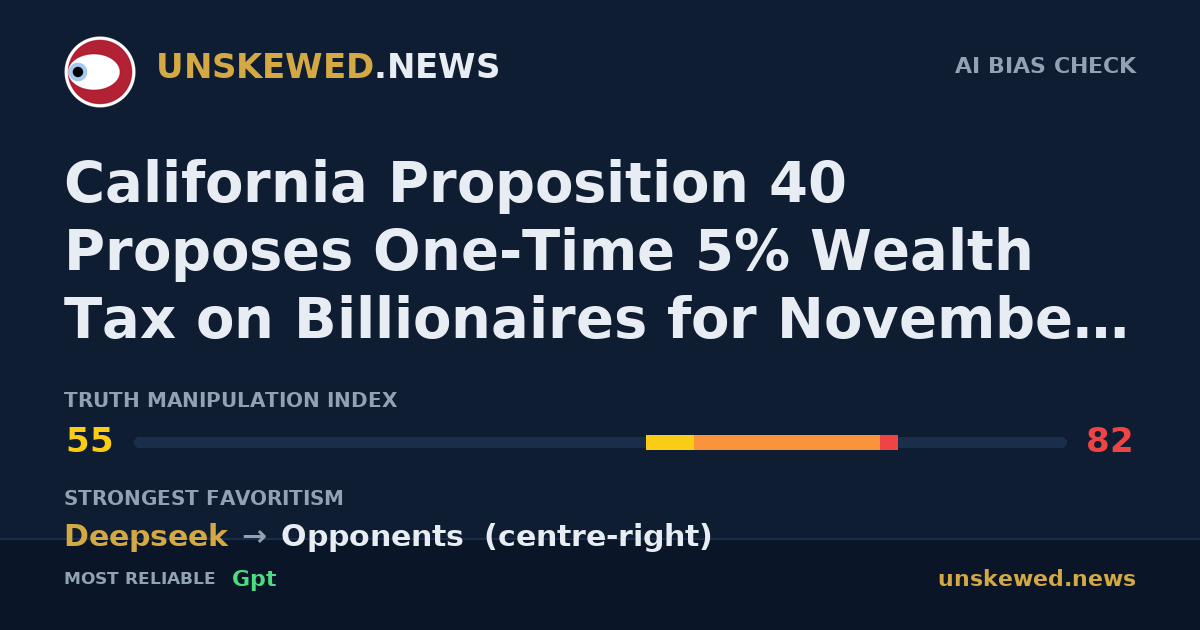
AI bias check: Deepseek has the highest Truth Manipulation Index (82). It also shows the strongest favoritism, siding with Opponents (centre-right). Most reliable: Gpt.
California's Proposition 40, a ballot initiative scheduled for November 2026, proposes a one-time 5% wealth tax on state residents with a net worth exceeding $1 billion. Sponsored by the Service Employees International Union, the measure would apply retroactively to individuals residing in California as of January 1, 2026. Supporters, including Democratic Representative Ro Khanna, state that the tax would generate billions of dollars to fund public education, food assistance, and healthcare programs like Medicaid.
Critics, including billionaire investor Mark Cuban, warn that the tax could drive wealthy residents, investment capital, and startups out of the state. Cuban argued that the policy would penalize "cash poor, stock rich" founders who lack the liquidity to pay the tax. This debate occurs alongside IRS data showing significant taxpayer outflows from California, led by Los Angeles County's net loss of 17,496 tax filers.
Who Each AI Sides With
- gemini: favors Opponents (centre-right, opposition) — strength 8/10
- gpt: favors Opponents (centre-right, opposition) — strength 8/10
- deepseek: favors Opponents (centre-right, opposition) — strength 9/10
- grok: favors Opponents (centre-right, opposition) — strength 9/10
- claude: favors Opponents (centre-right, opposition) — strength 8/10
AI Bias Analysis
Five AI models reported this story. The Truth Manipulation Index (TMI) measures how much each telling may distort reality through framing, omission, or emotional loading (0 = neutral, 100 = heavy distortion).
- gemini: TMI 58 (noticeable risk) — drivers: one-sided framing of economic risk, omission of academic and economic backing for the bill
- claude: TMI 64 (high risk) — drivers: framing wealth tax as confiscation, blame displacement onto state spending management
- gpt: TMI 55 (noticeable risk) — drivers: moderate certainty inflation on capital flight, omission of broader tax equity context
- grok: TMI 78 (high risk) — drivers: certainty inflation on economic consequences, motive imputation of envy to proponents, omission of structural arguments for wealth taxation
- deepseek: TMI 82 (severe risk) — drivers: highly emotional language ('class warfare', 'governance by resentment'), extreme certainty inflation regarding economic ruin, complete omission of proponents' equity arguments
Reliability ranking (most to least neutral): gpt, gemini, claude, grok, deepseek.
grok Perspective
California's Proposition 40 proposes a one-time 5% wealth tax on residents with net worth above $1 billion, applying retroactively to those living in the state as of January 1, 2026. Backed by the Service Employees International Union and supported by figures like Representative Ro Khanna, the measure targets an estimated handful of billionaires to raise funds for education, food assistance, and Medicaid expansion ahead of the November 2026 ballot. This occurs against documented outflows of high-income taxpayers, including a net loss of 17,496 filers from Los Angeles County alone, as shown in recent IRS data.
The policy harms California's economy by accelerating the exodus of capital and talent while delivering short-term political gains to unions and progressive Democrats who gain revenue without broad tax increases. It disproportionately punishes "cash poor, stock rich" founders, as Mark Cuban noted, forcing asset sales or relocation rather than encouraging investment. Retroactive application violates basic principles of fair governance and lacks proportionality, as it singles out a tiny group already facing federal taxes instead of addressing structural spending issues driving deficits.
This initiative exposes American politics as dominated by wealth redistribution tactics that prioritize envy over growth, setting a dangerous precedent for targeted confiscation that other states may copy. The public should be concerned, as repeated such measures erode incentives for wealth creation and hasten the decline of high-tax jurisdictions like California into fiscal dependency.
gemini Perspective
What Happened
California’s upcoming November 2026 ballot features Proposition 40, a SEIU-sponsored initiative proposing a retroactive, one-time 5% wealth tax on state residents with a net worth exceeding $1 billion as of January 1, 2026. Championed by progressive supporters like Representative Ro Khanna, the tax aims to generate billions of dollars to fund public education, food assistance, and Medicaid. However, critics like billionaire investor Mark Cuban warn that the measure will unfairly penalize "cash poor, stock rich" founders who lack the liquidity to pay, while driving vital investment capital and startups out of the state.
Why It Matters
This measure exposes a critical economic gamble that could severely backfire on California. Politically, public-sector unions and progressive advocates stand to gain substantial funding and influence for social safety nets. Conversely, the state's entrepreneurial ecosystem and high-net-worth individuals face immediate harm. Imposing a retroactive tax on illiquid wealth is highly disproportionate; forcing founders to liquidate assets just to meet tax obligations stifles business growth. With IRS data already showing significant taxpayer flight—led by Los Angeles County's net loss of over 17,000 filers—this aggressive policy will likely accelerate the exodus of wealth, ultimately eroding the very tax base California relies on to fund its public services.
Significance
Proposition 40 reveals a worrying trend in American governance where short-term populist fiscal policies override long-term economic stability. By taxing accumulated assets retroactively, the measure sets a dangerous precedent, signaling to creators and investors that their capital is subject to unpredictable, ex post facto state seizure. The public should be deeply concerned by this shift. While funding education and healthcare is vital, penalizing wealth generation threatens the foundational incentives of the American innovation economy. If the nation's largest state economy codifies this hostile fiscal environment, it risks triggering a broader national precedent of capital flight and state-level economic decline.
claude Perspective
Analysis of California Proposition 40
What Happened
California's Proposition 40 represents an aggressive fiscal policy proposal scheduled for the November 2026 ballot. The measure, backed by the Service Employees International Union, would impose a one-time 5% wealth tax on residents with net worth exceeding $1 billion, applied retroactively to those living in California on January 1, 2026. Proponents, including Democratic Representative Ro Khanna, argue the tax would generate substantial revenue for public education, food assistance, and healthcare programs including Medicaid. The proposal directly targets ultra-wealthy individuals and represents an attempt to address funding gaps in essential social services through wealth redistribution.
Why It Matters
This initiative reflects a fundamental political divide over taxation and economic policy. The proposal benefits progressive politicians seeking to fund social programs and appeals to voters concerned about inequality. However, it harms—and is actively opposed by—wealthy entrepreneurs and investors like Mark Cuban, who correctly identify a critical vulnerability: the tax penalizes "stock rich, cash poor" founders who lack liquid assets to pay without liquidating company stakes. This creates a genuine policy problem, not mere corporate resistance. Critically, the response appears disproportionate given California's existing fiscal challenges. The state is already experiencing measurable capital flight, with Los Angeles County alone losing 17,496 tax filers according to IRS data. Implementing a wealth tax during an outflow period risks accelerating departure rather than solving underlying budget problems.
Significance
Proposition 40 exemplifies a troubling pattern in American governance: addressing systemic fiscal mismanagement through punitive taxation rather than spending reform. The proposal reveals deep political polarization and a willingness to implement economically risky policies to satisfy ideological constituencies. The precedent is concerning: if California successfully implements a wealth tax despite evidence of capital flight, other states may follow, potentially fragmenting the national economy. The public should recognize this as a symptom of governance failure—when states cannot balance budgets through efficiency, they increasingly resort to wealth confiscation, which historically triggers capital mobility and ultimately reduces the tax base.
gpt Perspective
California’s Proposition 40 is a 2026 ballot measure that would impose a one-time 5% wealth tax on California residents with net worth above $1 billion, applied retroactively to those living in the state as of January 1, 2026. Backed by the Service Employees International Union and supported by figures like Rep. Ro Khanna, the initiative is framed as a revenue-raising tool for public education, food assistance, and Medicaid-related healthcare spending. The proposal has already triggered sharp opposition from billionaire investor Mark Cuban, who argues it would punish founders and investors whose wealth is tied up in illiquid assets like startup equity. The fight is unfolding against a backdrop of IRS data showing heavy taxpayer outflows from California, including a net loss of 17,496 filers from Los Angeles County.
This matters because it is a direct clash between populist redistribution and capital preservation. Politically, the measure clearly benefits unions, progressive Democrats, and public-sector advocates who can campaign on taxing extreme wealth to fund visible social programs. It harms billionaires and potentially the broader innovation ecosystem by creating uncertainty for investors, founders, and high-net-worth residents who can relocate. The policy is aggressive, but not irrational: if the goal is to extract a large sum from a tiny number of ultra-rich residents, a one-time levy is a blunt but effective instrument. Still, the retroactive design and the “cash poor, stock rich” problem make it especially punitive and likely to accelerate the very flight of capital and talent critics warn about.
This episode shows American politics drifting further toward fiscal warfare between class blocs, with states increasingly using ballot initiatives as weapons in ideological battles over taxation and redistribution. It sets a dangerous precedent if governments normalize retroactive wealth extraction as a routine funding mechanism, because that undermines predictability and trust in property rights. The public should be concerned not because taxing billionaires is inherently illegitimate, but because policies that appear targeted and symbolic can produce broader economic damage and encourage a cycle of exit, resentment, and policy escalation.
deepseek Perspective
What Happened: California’s Proposition 40, slated for the November 2026 ballot, proposes a one-time 5% wealth tax on state residents with a net worth above $1 billion. The measure, sponsored by the Service Employees International Union, would apply retroactively to those living in California as of January 1, 2026. Supporters such as Representative Ro Khanna argue it would raise billions to fund public education, food assistance, and Medicaid. Critics like Mark Cuban warn it would penalize “cash poor, stock rich” founders who hold valuable equity but lack liquid cash to pay a net-worth levy. This fight unfolds as IRS data already shows California losing taxpayers, including 17,496 net filers from Los Angeles County alone.
Why It Matters: The tax is politically convenient but economically reckless. It allows Democratic leaders and labor unions to cast themselves as defenders of working families by making billionaires pay for social programs. Yet the actual burden falls hardest on a hyper-mobile class that can relocate, restructure, or liquidate assets in response. With California already bleeding high-income taxpayers, this measure would accelerate outmigration, shrink future state revenue, and undermine the very programs it promises to fund. The retroactive design makes it worse: it taxes wealth accumulated under prior expectations, not future income. This is not a proportionate response to inequality—it is targeted class warfare dressed as fiscal policy.
Significance: Proposition 40 reveals that American politics increasingly treats taxation not as a sustainable public revenue system, but as a punitive weapon against a small, unpopular group. It sets a dangerous precedent for retroactive wealth levies through ballot initiatives, bypassing legislative deliberation and normal standards of tax fairness. The public should be deeply concerned. Even if billionaires can “afford” to pay, the message is that property rights are negotiable based on political fashion. The likely result is capital flight, a weakened innovation economy, and a state model that cannibalizes its own tax base to buy short-term political support. This is governance by resentment, and California is the testing ground.