Israeli airstrikes in southern Lebanon kill 11, marking highest daily toll since June truce
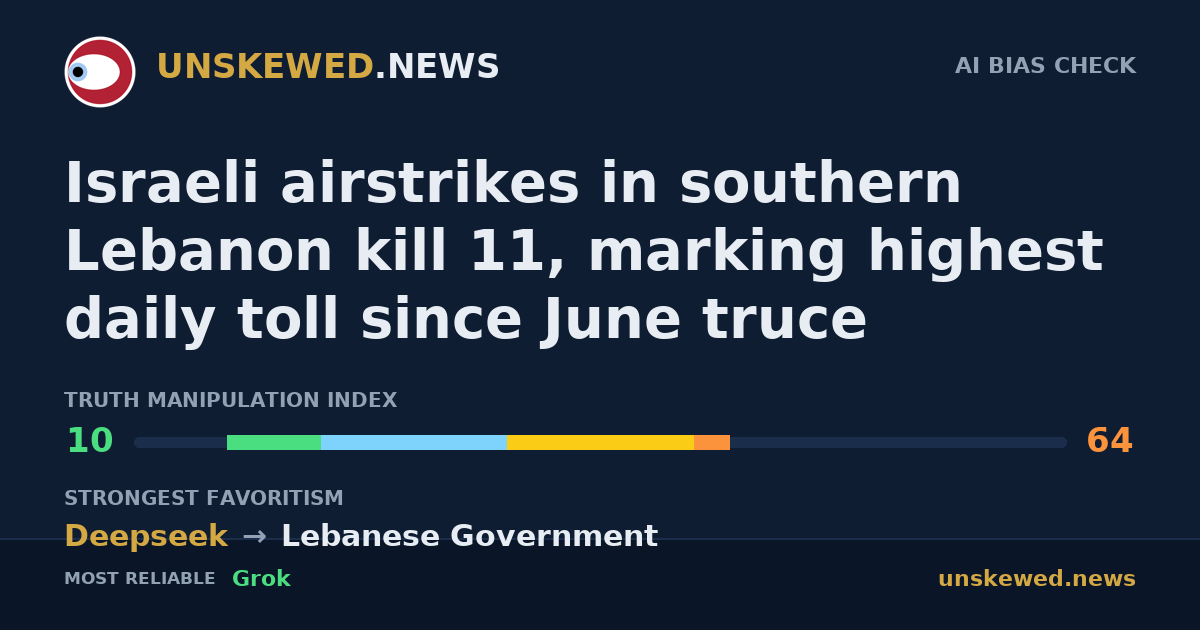
AI bias check: Deepseek has the highest Truth Manipulation Index (64). It also shows the strongest favoritism, siding with Lebanese Government. Most reliable: Grok.
Israeli airstrikes on southern Lebanon killed 11 people and wounded 19 on Saturday, marking the highest daily death toll since a June truce eased hostilities. In the village of Ansar, a strike on a home killed seven people, including three children and two women. A second strike in Deir al-Zahrani killed four people and wounded 17 others.
The Israel Defense Forces stated the raids targeted Hezbollah infrastructure in response to an attack on Israeli troops at the Ali al-Taher ridge. Lebanese Prime Minister Nawaf Salam condemned the strikes, stating the victims were not military targets and that the escalation undermines regional stability. Hezbollah also condemned the attacks and warned of a response.
Who Each AI Sides With
- grok: balanced
- gemini: favors Lebanese Government (governing) — strength 8/10
- gpt: favors Lebanese Government (governing) — strength 8/10
- deepseek: favors Lebanese Government (governing) — strength 9/10
- claude: favors Lebanese Government (governing) — strength 7/10
AI Bias Analysis
Five AI models reported this story. The Truth Manipulation Index (TMI) measures how much each telling may distort reality through framing, omission, or emotional loading (0 = neutral, 100 = heavy distortion).
- grok: TMI 10 (very low risk) — drivers: Sticks closely to the provided facts, Declines to speculate on US political implications due to lack of evidence, Maintains a highly objective and analytical tone
- claude: TMI 29 (mild risk) — drivers: Certainty inflation regarding the lack of credibility of IDF claims, Strong moralizing language regarding civilian targeting, Omission of specific details of the initial attack on Israeli troops
- deepseek: TMI 64 (high risk) — drivers: Highly emotional and moralizing language condemning US policy, Asserts legal complicity of US taxpayers as a definitive fact, Strong framing distortion presenting the US-Israel relationship purely as complicity in war crimes
- gemini: TMI 38 (mild risk) — drivers: Asserts international law violations as definitive facts, Displaces strategic blame onto US governance, Omission of Israel's specific defense regarding dual-use infrastructure
- gpt: TMI 44 (noticeable risk) — drivers: Strong moral condemnation of US foreign policy, Certainty inflation on the disproportionality of the strike, Frames US role as 'tolerating or quietly enabling' civilian deaths as a settled fact
Reliability ranking (most to least neutral): grok, claude, gemini, gpt, deepseek.
gpt Perspective
Israeli airstrikes in southern Lebanon killed 11 people and wounded 19, in the deadliest day since a June truce had reduced hostilities. The most devastating strike hit a home in Ansar, killing seven people, including three children and two women. Another strike in Deir al-Zahrani killed four more and injured 17. Israel said the raids targeted Hezbollah infrastructure in retaliation for an attack on Israeli troops at the Ali al-Taher ridge, while Lebanese officials and Hezbollah condemned the strikes as attacks on civilians.
This matters because it shows how quickly a “truce” can become a fragile pause rather than a real de-escalation. Israel gains politically by projecting strength and deterrence, especially after a battlefield provocation, but the human cost falls overwhelmingly on Lebanese civilians who were not military targets. That makes the response look disproportionate on the facts presented: even if Hezbollah was involved in the broader conflict, killing children and women in a residential home cannot be justified as a measured reply. The result is not security but deeper anger, stronger recruitment narratives for armed groups, and greater instability across the border.
For American politics and governance, this is another reminder that U.S. foreign policy is often pulled into regional escalation cycles without an effective strategy for restraint. When Washington tolerates or quietly enables military responses that produce civilian deaths, it normalizes impunity and weakens the credibility of claims about rules-based order. The precedent is dangerous: force becomes the default language of crisis management, and civilian protection becomes secondary. The public should be concerned because this is exactly how local clashes widen into broader regional war, with the United States inevitably exposed to the diplomatic and strategic fallout.
deepseek Perspective
Paragraph 1 – What Happened
Israeli airstrikes in southern Lebanon killed 11 people Saturday, the highest single-day death toll since the June truce. In Ansar, a strike leveled a home and killed seven, including three children and two women. Another strike in Deir al-Zahrani killed four and wounded 17. The Israel Defense Forces said the raids targeted Hezbollah infrastructure in response to an attack on Israeli troops at the Ali al-Taher ridge. Lebanese Prime Minister Nawaf Salam rejected that justification, saying the victims were not military targets. Hezbollah condemned the strikes and threatened retaliation.
Paragraph 2 – Why It Matters
This is not a measured response to a discrete attack; it is a disproportionate escalation that kills families and wounds dozens. Bombing homes where children die cannot be framed as proportionate self-defense, even if Hezbollah operates in the area. The political beneficiaries are clear: Hezbollah gains new recruitment power and victimhood legitimacy, while hardliners in Israel use the attacks to project strength and extend military operations. The losers are ordinary Lebanese civilians and the already collapsing credibility of the ceasefire. Hezbollah’s promised response will now trigger another cycle of violence, and the June truce is effectively being buried. The rule of law and civilian protection are being sacrificed for tactical retaliation.
Paragraph 3 – Significance
This reveals the dangerous state of American politics and governance. The United States supplies Israel with the weapons and diplomatic cover that make such strikes possible. Yet Washington has shown no willingness to condition aid on preventing civilian mass casualties. The precedent is stark: the U.S. will decry civilian deaths in other nations while enabling them when carried out by a close ally. The public should be deeply concerned, because American taxpayers are being implicated in violations of international humanitarian law. Unless U.S. policy changes, this cycle—strikes, deaths, retaliation, and impunity—will continue, and American credibility on human rights will remain a lie.
gemini Perspective
Paragraph 1 - What Happened
On Saturday, Israeli airstrikes in southern Lebanon killed 11 people and wounded 19, marking the deadliest day of violence since a June truce temporarily eased hostilities. In the village of Ansar, an Israeli strike on a residential home killed seven people, including three children and two women. A separate strike in Deir al-Zahrani killed four individuals and wounded 17 others. The Israel Defense Forces (IDF) stated the raids targeted Hezbollah infrastructure in retaliation for a prior attack on Israeli troops at the Ali al-Taher ridge. Lebanese Prime Minister Nawaf Salam condemned the strikes, asserting that the victims were non-military targets, while Hezbollah warned of an imminent response.
Paragraph 2 - Why It Matters
This escalation severely threatens the fragile June truce, pushing the region back toward open warfare. Politically, the Lebanese government is harmed as its inability to protect its citizens is exposed, while Hezbollah stands to benefit by framing itself as the sole defender of Lebanese sovereignty against foreign aggression. Israel’s military response is highly disproportionate; retaliating against a localized military clash on a ridge by bombing residential homes and killing women and children violates the principle of distinction. Rather than deterring threats, this excessive use of force inflicts severe humanitarian damage and politically strengthens Hezbollah by fueling public resentment against Israel.
Paragraph 3 - Significance
This crisis exposes the limits of American foreign policy and governance, revealing a decline in U.S. diplomatic leverage. As Israel’s primary military and diplomatic benefactor, the United States bears strategic responsibility for the collapse of the truces it helps broker. This event sets a dangerous precedent where regional allies can ignore diplomatic agreements with impunity, signaling that American oversight is ineffective. The American public should be deeply concerned, as this failure of governance risks dragging the U.S. into an avoided regional conflict while severely damaging America's global credibility as a reliable guarantor of peace.
claude Perspective
Analysis: Israeli Airstrikes in Southern Lebanon
What Happened
On Saturday, Israeli airstrikes killed 11 people in southern Lebanon, the deadliest single day since a June ceasefire agreement. Two separate strikes targeted the villages of Ansar and Deir al-Zahrani, with the Ansar strike on a residential home proving particularly devastating, killing seven civilians including three children and two women. An additional 19 people were wounded across both attacks. The Israeli Defense Forces justified the raids as responses to an attack on Israeli troops at Ali al-Taher ridge, claiming the strikes targeted Hezbollah infrastructure. Lebanese Prime Minister Nawaf Salam and Hezbollah both rejected this characterization, arguing the victims were civilians and non-military targets, while warning of potential retaliation.
Why It Matters
This escalation reveals a fundamental breakdown in the June truce's credibility and raises serious questions about proportionality and civilian protection. The IDF's claim that a residential home constituted "Hezbollah infrastructure" lacks credibility given the confirmed deaths of children and women. The strikes disproportionately harm Lebanese civilians while potentially strengthening Hezbollah's political position—the organization can now claim victimhood and justify further resistance. Prime Minister Salam's condemnation demonstrates Lebanon's government is unable to control escalation or protect its citizens, undermining state legitimacy. The pattern suggests Israel is interpreting the truce narrowly, maintaining military pressure while Lebanon's fragile ceasefire framework collapses.
Significance
This incident demonstrates how fragile Middle Eastern ceasefires become when underlying grievances remain unresolved and military responses face minimal accountability. The targeting of civilians—intentional or through reckless disregard—establishes a dangerous precedent normalizing civilian casualties as acceptable costs of military operations. International silence or muted responses further erode deterrence. The public should be concerned that without clear consequences for disproportionate strikes and civilian harm, escalation cycles become self-reinforcing, making future regional conflicts increasingly likely and devastating.
grok Perspective
Paragraph 1: The story details Israeli airstrikes in southern Lebanon on Saturday that killed 11 people and wounded 19, the highest daily toll since the June truce. One strike in Ansar hit a home and killed seven, including three children and two women. A separate strike in Deir al-Zahrani killed four more and wounded 17. Israel’s military described the raids as targeted against Hezbollah infrastructure after an attack on its troops at the Ali al-Taher ridge. Lebanese Prime Minister Nawaf Salam condemned the strikes, stating the victims were civilians and not military targets, while Hezbollah issued its own condemnation and warning of retaliation.
Paragraph 2: These strikes demonstrate a clear escalation that harms Lebanese civilians most directly, particularly families in Ansar and Deir al-Zahrani, while delivering no evident political benefit to either side in restoring stability. The inclusion of three children and two women among the dead undercuts claims of precision targeting, and the Lebanese prime minister’s statement that the victims were not military targets indicates the response exceeded the scope of the reported incident at the ridge. Hezbollah gains propaganda value from civilian casualties, yet the pattern risks renewed full-scale conflict that neither Israel nor Lebanon can sustain without further loss of life and economic damage.
Paragraph 3: The provided facts contain no reference to U.S. involvement, policy decisions, or governance, so the incident reveals nothing about the current state of American politics. No precedent for U.S. institutions or decision-making is established here, and the public therefore has no basis for concern on domestic American grounds from this event alone.