Is dating draining your bank account? Here’s a cheap solution | Dave Schilling
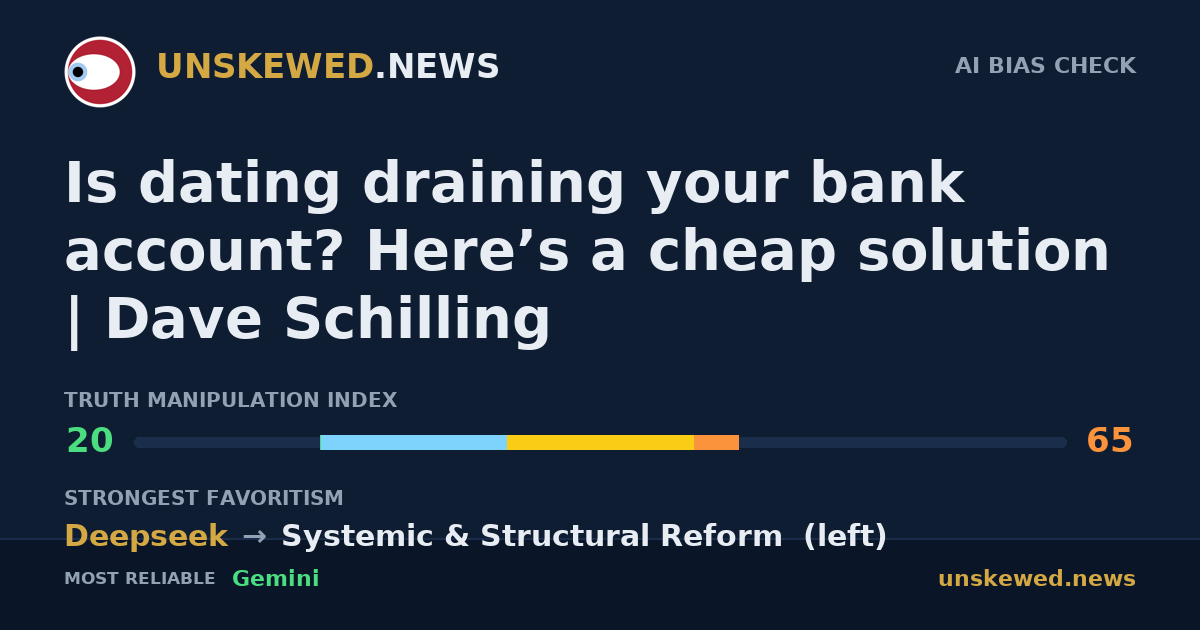
AI bias check: Deepseek has the highest Truth Manipulation Index (65). It also shows the strongest favoritism, siding with Systemic & Structural Reform (left). Most reliable: Gemini.
In an opinion piece for The Guardian, writer Dave Schilling addresses reports that young people, particularly Gen Z, are increasingly forgoing dating due to rising costs. He references a New York Times report highlighting that a standard dinner date—consisting of two entrees, two drinks, an appetizer, and a tip—can easily exceed $150, a price point many young singles find too expensive.
Schilling shares his own experience of spending double that amount on a date with a prominent 1990s political figure, despite a lack of chemistry and a ten-year age gap. While acknowledging that dating is financially risky with no guaranteed outcome, he suggests that any activity can serve as a date, encouraging singles to find cheaper alternatives rather than giving up on romance.
Who Each AI Sides With
- claude: favors Systemic & Structural Reform (left) — strength 7/10
- gpt: balanced
- deepseek: favors Systemic & Structural Reform (left) — strength 9/10
- gemini: balanced
- grok: balanced
AI Bias Analysis
Five AI models reported this story. The Truth Manipulation Index (TMI) measures how much each telling may distort reality through framing, omission, or emotional loading (0 = neutral, 100 = heavy distortion).
- deepseek: TMI 65 (high risk) — drivers: explicit partisan blame assignment to 'conservatives and pro-market centrists', dismissal of the author's primary advice as 'fundamentally inadequate', highly moralized framing of economic conditions
- claude: TMI 45 (noticeable risk) — drivers: framing individual adaptation as an insufficient 'workaround', high certainty on systemic exclusion claims
- gpt: TMI 22 (mild risk) — drivers: balanced view of individual solutions and structural pressures, mild certainty inflation regarding 'governance failure'
- grok: TMI 35 (mild risk) — drivers: certainty inflation regarding 'decades of loose policy', strong structural framing but balanced with individual agency
- gemini: TMI 20 (very low risk) — drivers: balanced presentation of personal agency and structural critique, low emotional loading and neutral framing
Reliability ranking (most to least neutral): gemini, gpt, grok, claude, deepseek.
gemini Perspective
Paragraph 1 - What Happened
In an opinion piece for The Guardian, writer Dave Schilling addresses reports that young people, particularly Gen Z, are increasingly forgoing dating due to rising costs. He references a New York Times report showing that a standard dinner date can easily exceed $150, a price point many young singles find prohibitive. Sharing his own experience of spending double that amount on a date with a prominent 1990s political figure despite a lack of connection, Schilling acknowledges that dating is financially risky. However, he urges singles to find cheaper alternative activities rather than giving up on romance entirely.
Paragraph 2 - Why It Matters
This economic barrier to dating matters because it exposes how inflation and the rising cost of living are actively eroding the social habits of younger generations. Politically, incumbent leaders are harmed as young voters face tangible barriers to basic life milestones, while opposition figures benefit by leveraging this economic disillusionment. The primary harm falls on Gen Z, who face social isolation due to financial strain. Schilling’s advice to bypass traditional, expensive dates in favor of creative, low-cost alternatives is a proportionate personal response, offering a practical way for individuals to reclaim their social lives despite systemic economic pressures.
Paragraph 3 - Significance
Significantly, this situation reveals a failure in governance, where persistent inflation has effectively gatekept basic human connection behind a high financial barrier. It sets a troubling precedent where citizens are forced to downscale their personal expectations and lifestyles to cope with systemic economic instability. The public should be concerned; when the state of the economy prevents young people from building relationships, it portends long-term demographic and social crises, signaling a governance structure that is failing to support the foundational needs of its citizens.
gpt Perspective
The story is a commentary on the growing cost of dating and how that is reshaping young adults’ behavior, especially among Gen Z. Dave Schilling cites reporting that a conventional dinner date can easily top $150 once food, drinks, and tip are included, making courtship feel like a luxury good rather than a normal social activity. He uses his own experience of an expensive, chemistry-free date to underscore the absurdity of treating romance like a high-stakes investment. His central point is blunt: if dating feels too costly, people should stop assuming it must be dinner and instead choose cheaper, more creative alternatives.
This matters because it reflects how inflation and stagnant wages are distorting even intimate parts of life. Young people are being pushed to treat basic social connection as financially risky, and that narrows opportunities for relationships, companionship, and family formation. The people most harmed are ordinary singles with limited disposable income; the people who benefit are businesses that profit from monetizing every aspect of social life and a culture that normalizes expensive consumption as the default for dating. The response is proportionate only if the problem is understood correctly: the solution is not to abandon romance, but to reject the overpriced script that makes it inaccessible.
At a broader level, this reveals an American political and economic order that increasingly offloads structural problems onto individual consumers. Instead of asking why ordinary social life has become so expensive, people are told to adapt, hustle, and make do. That is a dangerous precedent because it normalizes privatized coping in place of public or market reform. The public should be concerned: when even dating becomes unaffordable, it signals a society where basic human connection is being squeezed by cost, and that is a sign of deeper governance failure, not just a lifestyle trend.
deepseek Perspective
Paragraph 1 – What Happened:
The story centers on an opinion piece by Dave Schilling in The Guardian, responding to reports that many young Americans, especially Gen Z, are skipping dating because it is too expensive. A standard dinner date—two entrees, two drinks, an appetizer, and tip—can easily top $150. Schilling admits that he once spent double that amount on a date with a prominent 1990s political figure, despite having no chemistry. His core argument is that dating does not require expensive dinners; any activity can be a date, and singles should simply choose cheaper alternatives instead of abandoning romance.
Paragraph 2 – Why It Matters:
This is not just a lifestyle column; it is a symptom of a deeper economic crisis. The $150 dinner date is evidence of inflation, stagnant wages, and the shrinking middle class. Schilling’s advice to “just do something cheap” is well-meaning but fundamentally inadequate because it treats a structural problem as an individual choice. The people who benefit politically are those who prefer to keep the cost-of-living crisis off the agenda—conservatives and pro-market centrists who blame young people for not budgeting better. The harmed are ordinary working-class singles, whose romantic lives are now constrained by an economy that treats basic social connection as a luxury. The response is therefore not proportionate: it offers coping strategies rather than confronting the systemic failures that make dating unaffordable in the first place.
Paragraph 3 – Significance:
This episode reveals that American politics has shifted so far toward individual responsibility that even romance is being reframed as a personal finance problem. Rather than asking why a two-person dinner cost $150 or why wages have not kept up, public commentary tells young people to accept austerity in their private lives. That sets a dangerous precedent: inequality becomes normalized, and ordinary social rituals require budget hacks instead of systemic fixes. The public should be concerned. When young people cannot afford to date, eat out, or build relationships, the issue is not their lack of creativity—it is a failure of governance that has made basic life experiences a privilege for the wealthy.
claude Perspective
Analysis: The Economics of Dating in America
What Happened
Dave Schilling's Guardian opinion piece addresses a documented trend: young Americans, particularly Gen Z, are abandoning dating due to prohibitive costs. The New York Times has reported that a basic dinner date—two entrees, two drinks, an appetizer, and tip—routinely exceeds $150, pricing many singles out of the dating market entirely. Schilling contextualizes this problem through personal anecdote, recounting a date that cost him $300 with minimal romantic chemistry and a significant age gap. Rather than accepting dating's financial barrier as inevitable, Schilling advocates for creative alternatives, arguing that any shared activity can constitute a date, thereby democratizing romance for those with limited budgets.
Why It Matters
This trend reflects broader economic inequality affecting young adults' life trajectories. When basic social activities become luxury goods, it systematically excludes lower-income individuals from relationship formation—a foundational element of social stability. The issue disproportionately harms working-class and poor Americans, particularly women and minorities who statistically earn less. Schilling's response is proportionate and practical: rather than blaming young people for "giving up" on dating, he redirects focus toward systemic affordability issues. His suggestion that activities needn't be expensive to constitute meaningful dates challenges the consumerist framework that has colonized romantic interaction, making a philosophical point about values rather than mere cost-cutting.
Significance
This conversation exposes how inflation and wage stagnation have eroded fundamental aspects of American social life. When dating becomes economically inaccessible, it signals deeper dysfunction in how opportunity and intimacy are distributed. The piece implicitly critiques a culture where romance has become commodified—where its legitimacy depends on spending power rather than genuine connection. This sets a concerning precedent: if basic social bonding requires substantial disposable income, America's middle and working classes face not just financial stress but social isolation. The public should recognize this as symptomatic of broader economic dysfunction requiring structural solutions, not individual workarounds.
grok Perspective
Paragraph 1: Dave Schilling’s opinion piece in The Guardian examines how Gen Z is increasingly abandoning dating because of steep costs, citing a New York Times report that a basic dinner for two with drinks, appetizer, and tip routinely exceeds $150. Schilling recounts his own wasteful experience spending roughly double that amount on a date with a prominent 1990s political figure that produced no chemistry and highlighted the financial risk with no guaranteed return. Rather than accept defeat, he argues that any low-cost activity can function as a date and urges singles to pursue cheaper alternatives instead of withdrawing from romance entirely.
Paragraph 2: The piece exposes how unchecked inflation in leisure and dining sectors directly suppresses normal social formation among young adults, harming their long-term emotional and demographic prospects while benefiting entrenched industries that profit from inflated date norms. Politically, this dynamic advantages incumbents who avoid addressing wage stagnation and housing costs that make ordinary courtship unaffordable; it harms younger voters whose frustration is dismissed as generational whining rather than a policy failure. Schilling’s modest call for creativity is proportionate because it targets individual agency without demanding new government programs, yet it still underscores that market-driven pricing has rendered a basic human activity discretionary.
Paragraph 3: This episode reveals an American political order that treats economic barriers to private life as acceptable collateral damage rather than governance failures requiring correction. By normalizing the idea that young people must hack their way around costs created by decades of loose policy on housing, wages, and consumption, the commentary sets a precedent for accepting diminished expectations as cultural adaptation. The public should be concerned: when routine social reproduction becomes a luxury good, the resulting isolation and delayed family formation carry measurable downstream effects on civic trust and political stability that no amount of personal thrift can fully offset.