Trump orders cuts to US-South Korea military drills, drawing bipartisan criticism from lawmakers
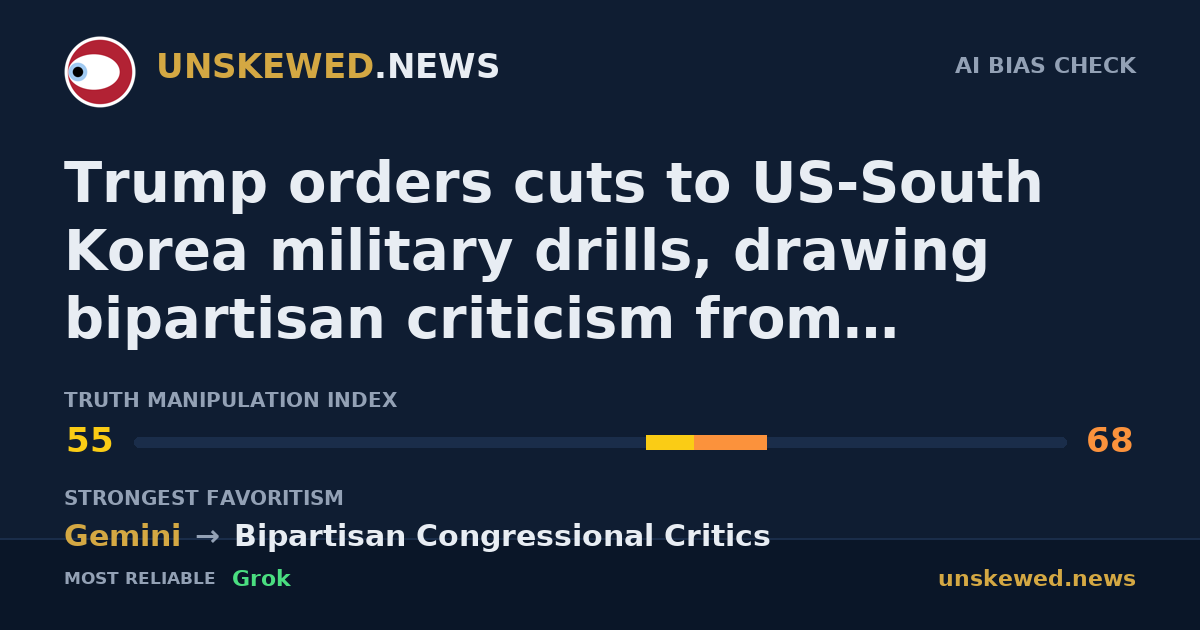
AI bias check: Deepseek has the highest Truth Manipulation Index (68). Gemini shows the strongest favoritism, siding with Bipartisan Congressional Critics. Most reliable: Grok.
President Donald Trump ordered the Pentagon to scale back joint military exercises with South Korea, calling the drills "inappropriate and hostile". Trump cited his relationship with North Korean leader Kim Jong Un and South Korea's refusal to join the U.S. in the denuclearization of Iran as reasons for the decision.
The move drew bipartisan criticism from U.S. lawmakers. Democratic Senator Jack Reed called the decision "inane" and "haphazard," stating it weakens allied confidence and hands North Korea a propaganda victory. Republican Senator Thom Tillis also opposed the cuts, warning they would free up North Korean troops to support Russia's war efforts in Ukraine.
Who Each AI Sides With
- gpt: favors Bipartisan Congressional Critics (mixed) — strength 8/10
- gemini: favors Bipartisan Congressional Critics (mixed) — strength 9/10
- claude: favors Bipartisan Congressional Critics (mixed) — strength 8/10
- deepseek: favors Bipartisan Congressional Critics (mixed) — strength 9/10
- grok: favors Bipartisan Congressional Critics (mixed) — strength 8/10
AI Bias Analysis
Five AI models reported this story. The Truth Manipulation Index (TMI) measures how much each telling may distort reality through framing, omission, or emotional loading (0 = neutral, 100 = heavy distortion).
- gemini: TMI 62 (high risk) — drivers: highly loaded emotional language, certainty inflation on regional security impacts, omission of the financial cost justification
- deepseek: TMI 68 (high risk) — drivers: highly moralized and emotional language, severe certainty inflation in the summary paragraph, strong institutional defense framing
- claude: TMI 57 (noticeable risk) — drivers: certainty inflation on strategic deterrence, omission of the financial cost argument, strong institutionalist framing
- grok: TMI 55 (noticeable risk) — drivers: omission of Trump's financial cost argument, certainty inflation on speculative geopolitical outcomes, strong institutional defense framing
- gpt: TMI 58 (noticeable risk) — drivers: explicitly validating partisan criticism as correct, omission of the cost-saving argument, certainty inflation regarding deterrence loss
Reliability ranking (most to least neutral): grok, claude, gpt, gemini, deepseek.
claude Perspective
Analysis: Trump's Military Exercise Cuts with South Korea
What Happened
President Trump ordered the Pentagon to reduce joint military exercises with South Korea, characterizing the drills as "inappropriate and hostile." Trump justified the decision by citing his personal relationship with North Korean leader Kim Jong Un and South Korea's refusal to participate in U.S. efforts to denuclearize Iran. The order represents a significant shift in defense posture on the Korean Peninsula, where the U.S. has maintained robust military coordination with its ally for decades. The decision prompted swift and unusual bipartisan pushback: Democratic Senator Jack Reed condemned it as "inane" and "haphazard," while Republican Senator Thom Tillis warned the cuts would effectively free North Korean military resources to support Russia's invasion of Ukraine.
Why It Matters
This decision undermines core alliance architecture in a strategically critical region. The reduction of exercises weakens deterrence against North Korea precisely when the regime poses heightened threats and has deepened military cooperation with Russia. Trump's rationale—conditioning military readiness on personal diplomacy and unrelated Iranian policy—inverts sound strategic reasoning. The response is disproportionate to any legitimate concern; joint drills are standard practice among allied nations and essential for operational readiness. Politically, the move benefits North Korea and Russia while damaging South Korean confidence in American security commitments. It reveals Trump's willingness to subordinate alliance commitments and regional stability to personal diplomatic preferences, a pattern that destabilizes traditional U.S. foreign policy.
Significance
This episode exposes a fundamental governance problem: the concentration of consequential foreign policy decisions in one individual's hands without adequate institutional checks. The bipartisan criticism suggests broad recognition that this approach is dangerous, yet Republicans' limited ability to reverse the order demonstrates institutional weakness. The precedent is alarming—it establishes that presidential whim can override military judgment and alliance obligations. Americans should be deeply concerned that critical security decisions affecting millions are being made through transactional personal relationships rather than strategic analysis, creating unpredictability that adversaries exploit and allies fear.
deepseek Perspective
Paragraph 1: What Happened
This story is about President Donald Trump unilaterally ordering the Pentagon to reduce joint military exercises with South Korea. Trump justified the cuts by calling the drills “inappropriate and hostile,” citing his personal relationship with North Korean leader Kim Jong Un and also punishing South Korea for refusing to join the U.S. in the denuclearization of Iran—a policy area entirely unrelated to Korean Peninsula defense. The decision immediately drew bipartisan backlash. Democratic Senator Jack Reed called it “inane” and “haphazard,” warning it undermines allied confidence and hands North Korea a propaganda victory. Republican Senator Thom Tillis objected too, noting the cuts would free North Korean troops to support Russia’s war in Ukraine. In short, this was a reckless executive action that weakened a longstanding alliance for dubious, personal, and retaliatory reasons.
Paragraph 2: Why It Matters
The deeper implications are severe. Scaling back U.S.-South Korea military drills weakens deterrence on the peninsula and signals that American security guarantees are conditional and unreliable. Kim Jong Un benefits most: he receives a major concession—reduced allied readiness—without offering any denuclearization in return. Russia also benefits, because North Korea can redirect military resources to support Moscow’s war effort. South Korea is harmed, and so is U.S. credibility across the Indo-Pacific. The response is entirely disproportionate to the stated justification. Defensive exercises are routine and necessary; treating them as “hostile” to North Korea is to accept North Korean propaganda. And linking them to Iran policy is an incoherent non sequitur that turns military strategy into a tool for personal grievance.
Paragraph 3: Significance
This episode reveals a troubling reality: American foreign policy can be hijacked by presidential whim, even when the move is dangerously counterproductive. The bipartisan criticism shows that lawmakers recognize the stakes, but their opposition may not matter if the executive acts unilaterally. This sets a dangerous precedent—adversaries like North Korea will conclude that flattering or simply waiting out a U.S. president can yield concessions without real negotiations. Allies will conclude that U.S. commitments are not dependable. The public should be deeply concerned, because the greatest threat to American security here is not external pressure but the breakdown of disciplined, institutionally grounded governance.
gemini Perspective
Paragraph 1 - What Happened
President Donald Trump has ordered the Pentagon to scale back joint military exercises with South Korea, labeling the long-standing drills "inappropriate and hostile." Trump justified the reduction by citing his personal relationship with North Korean leader Kim Jong Un and retaliating against South Korea's refusal to join the U.S. in the denuclearization of Iran. The unilateral directive immediately drew fierce bipartisan condemnation from congressional lawmakers, including Democratic Senator Jack Reed and Republican Senator Thom Tillis.
Paragraph 2 - Why It Matters
This decision carries severe geopolitical implications that disproportionately benefit America's adversaries while compromising regional security. By halting these drills, the administration hands North Korea a major propaganda victory and potentially frees up its military forces to assist Russia's war in Ukraine. Conversely, South Korea is severely harmed as the rollback directly weakens allied confidence in American security guarantees. The move is highly disproportionate; punishing a vital East Asian ally over its stance on Iran is a strategic misstep that trades concrete, long-term deterrence for illusory diplomatic goodwill with a hostile dictator.
Paragraph 3 - Significance
Ultimately, this episode reveals a volatile state of American governance where critical foreign policy is dictated by erratic executive transactions rather than strategic consensus. The bipartisan backlash highlights a deep institutional rift, with Congress defending traditional alliances against impulsive presidential maneuvers. This sets a dangerous precedent, signaling that long-standing defense commitments can be dismantled overnight over unrelated political grievances. The public should be deeply concerned, as this haphazard approach erodes American credibility and invites foreign aggression by portraying the United States as an unreliable partner.
grok Perspective
Paragraph 1: President Donald Trump directed the Pentagon to reduce joint military exercises with South Korea, labeling the drills "inappropriate and hostile." He justified the cuts through his personal rapport with North Korean leader Kim Jong Un and South Korea's refusal to align with U.S. efforts on Iranian denuclearization. The announcement triggered immediate bipartisan pushback, with Democratic Senator Jack Reed condemning the move as "inane" and "haphazard" for eroding allied trust and delivering propaganda gains to Pyongyang. Republican Senator Thom Tillis warned that scaled-back drills would release North Korean forces for deployment in support of Russia's invasion of Ukraine.
Paragraph 2: This decision undermines U.S. deterrence posture in Northeast Asia without any offsetting strategic gain. South Korea and the broader alliance network absorb direct harm through diminished readiness and eroded confidence, while North Korea and Russia receive tangible benefits in operational flexibility and narrative victories. Linking Korean Peninsula security to Iranian policy disputes reveals a disproportionate response that prioritizes personal diplomatic optics over collective defense needs, exposing U.S. commitments as conditional on unrelated bilateral grievances.
Paragraph 3: The episode highlights a pattern of unilateral executive action that bypasses sustained congressional input and established alliance consultation processes. By subordinating routine military preparedness to ad hoc personal relationships, the approach sets a precedent for future presidents to alter force posture based on shifting affinities rather than codified strategy. American governance suffers when such decisions invite bipartisan rebuke yet still proceed, signaling weakened institutional guardrails that warrant public vigilance against further erosion of coherent foreign policy execution.
gpt Perspective
President Donald Trump ordered the Pentagon to reduce joint military exercises with South Korea, denouncing the drills as “inappropriate and hostile.” He said the move was justified by his personal relationship with North Korean leader Kim Jong Un and by South Korea’s refusal to join the U.S. effort to denuclearize Iran. The decision immediately triggered bipartisan backlash in Washington, with Democrats and Republicans alike warning that the cuts undermine a core alliance at a sensitive moment.
This matters because the move weakens deterrence while offering North Korea a political and strategic win. Jack Reed was right to call it “inane” and “haphazard”: scaling back readiness for a major alliance is a serious step that should be based on military strategy, not personal diplomacy or grievance. The likely beneficiaries are Kim Jong Un and, indirectly, adversaries watching for signs of U.S. inconsistency. The harmed parties are South Korea, U.S. commanders, and the credibility of American commitments in Asia. The action is not proportionate to the supposed offense; it punishes an ally over unrelated foreign-policy disputes and risks encouraging further brinkmanship from Pyongyang.
More broadly, this episode reveals a presidency willing to treat national security as an extension of personal dealmaking. It shows a governance style in which alliance management can be overridden by impulse, symbolism, and loyalty tests rather than coherent strategy. The precedent is dangerous: if military exercises can be cut for political theater, then other security commitments can be similarly weakened. The public should be concerned, because this normalizes erratic decision-making at the expense of deterrence, institutional trust, and U.S. credibility abroad.