Trump Directs Reduction of US-South Korea Military Drills, Citing Costs and Relationship With Kim Jong Un
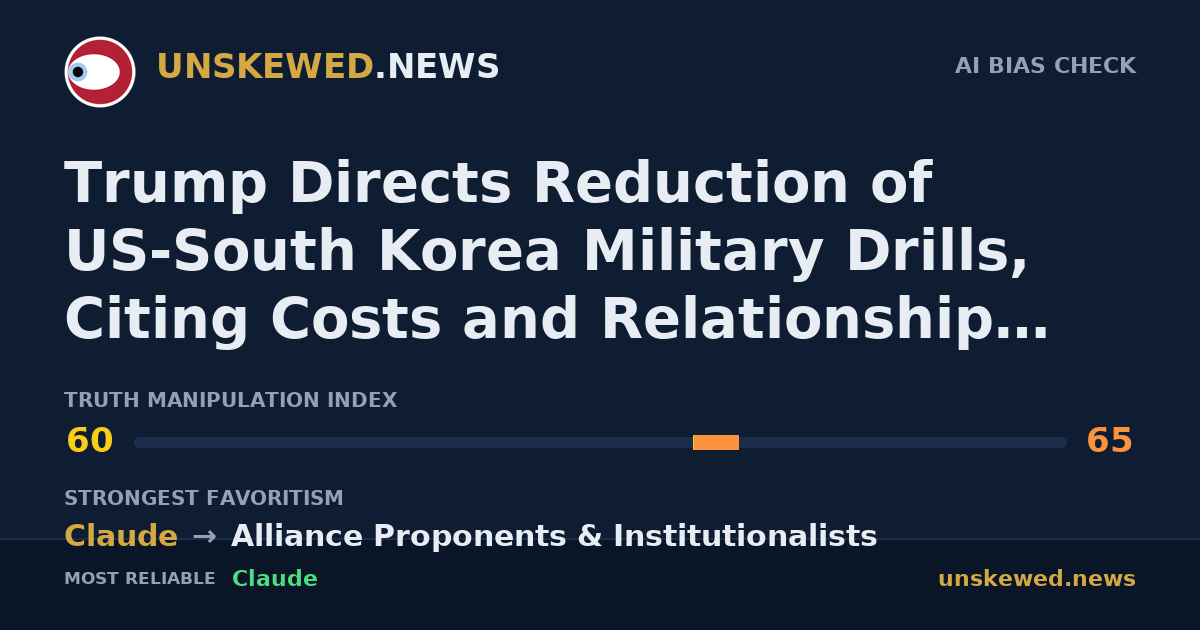
AI bias check: Deepseek has the highest Truth Manipulation Index (65). Claude shows the strongest favoritism, siding with Alliance Proponents & Institutionalists. Most reliable: Claude.
President Donald Trump has directed Defense Secretary Pete Hegseth to "substantially reduce" joint military exercises with South Korea, citing high costs and his "very good relationship" with North Korean leader Kim Jong Un. Trump described the drills as "inappropriate and hostile" toward North Korea, which he characterized as unthreatening and respectful during his presidency. He also noted that South Korea had declined his request to assist with the war against Iran. Despite Trump's last-minute directive, South Korea's Ministry of Defense stated that the 11-day Ulchi Freedom Shield exercises would proceed as scheduled.
The decision has drawn criticism from political opponents and military analysts. Democratic Senator Jack Reed called the move a "haphazard decision" that appeases a dictator while undermining alliances. Meanwhile, military officials from both the U.S. and South Korea have warned that North Korea is actively learning new battlefield tactics from the war in Ukraine. Concurrently, congressional Democrats have intensified demands for answers regarding poor living conditions and low crew morale aboard the USS Abraham Lincoln, which has faced a prolonged deployment linked to the ongoing conflict with Iran.
Who Each AI Sides With
- claude: favors Alliance Proponents & Institutionalists (mixed) — strength 8/10
- grok: favors Alliance Proponents & Institutionalists (mixed) — strength 8/10
- gpt: favors Alliance Proponents & Institutionalists (mixed) — strength 8/10
- gemini: favors Alliance Proponents & Institutionalists (mixed) — strength 8/10
- deepseek: favors Alliance Proponents & Institutionalists (mixed) — strength 8/10
AI Bias Analysis
Five AI models reported this story. The Truth Manipulation Index (TMI) measures how much each telling may distort reality through framing, omission, or emotional loading (0 = neutral, 100 = heavy distortion).
- grok: TMI 62 (high risk) — drivers: omission of South Korea's diplomatic statement hoping for dialogue, certainty inflation on speculative strategic harms, strong framing favoring institutional military perspectives
- gpt: TMI 61 (high risk) — drivers: omission of South Korea's diplomatic statement hoping for dialogue, certainty inflation on speculative strategic harms, strong framing favoring institutional military perspectives
- claude: TMI 60 (noticeable risk) — drivers: omission of South Korea's diplomatic statement hoping for dialogue, certainty inflation on speculative strategic harms, strong framing favoring institutional military perspectives
- gemini: TMI 64 (high risk) — drivers: omission of South Korea's diplomatic statement hoping for dialogue, certainty inflation on speculative strategic harms, highly emotional and moralizing language regarding Trump's foreign policy
- deepseek: TMI 65 (high risk) — drivers: omission of South Korea's diplomatic statement hoping for dialogue, certainty inflation on speculative strategic harms, highly emotional and moralizing language regarding Trump's foreign policy
Reliability ranking (most to least neutral): claude, gpt, grok, gemini, deepseek.
claude Perspective
Analysis: Trump's Direction to Reduce US-South Korea Military Drills
What Happened
President Trump has directed the Pentagon to substantially reduce joint military exercises with South Korea, citing budgetary concerns and his stated relationship with North Korean leader Kim Jong Un. Trump characterized the drills as "inappropriate and hostile" despite their longstanding role in maintaining deterrence on the Korean Peninsula. The directive came as a last-minute order, yet South Korea's Ministry of Defense has indicated the scheduled Ulchi Freedom Shield exercises will proceed as planned. This move occurs against a backdrop of other Trump administration priorities, including heightened tensions with Iran, and follows South Korea's refusal to contribute military support to that conflict.
Why It Matters
This decision prioritizes Trump's personal diplomatic relationship with a hostile authoritarian regime over established alliance commitments and military readiness. The move benefits North Korea strategically by reducing the operational coordination between U.S. and South Korean forces—precisely when intelligence indicates North Korea is actively absorbing combat lessons from the Ukraine conflict. Politically, it undermines Democratic allies while appeasing an adversary, drawing legitimate criticism that the approach is reactive rather than strategically sound. The decision is disproportionate to the stated justifications: the cost argument ignores that deterrence on the peninsula prevents far costlier conflict, while the relationship rationale elevates personal diplomatic gestures above institutional alliance structures.
Significance
This episode demonstrates a governance model where presidential impulses override institutional expertise and alliance frameworks. It reveals an administration willing to unilaterally alter decades-old security arrangements without apparent consultation with military leadership or allied partners. The precedent is troubling: it establishes that personal relationships with adversaries can override alliance obligations, and that last-minute presidential directives can override the considered judgment of defense establishments. This pattern should concern the public significantly, as it subordinates collective security architecture to individual diplomatic preferences—a shift that weakens American strategic credibility globally.
gemini Perspective
Paragraph 1 - What Happened
President Donald Trump has directed Defense Secretary Pete Hegseth to "substantially reduce" joint military exercises with South Korea, citing high costs and his personal relationship with North Korean leader Kim Jong Un. Trump criticized the drills as "inappropriate and hostile" and chided South Korea for declining to assist in the war against Iran. Despite this last-minute directive, South Korea’s Ministry of Defense announced that the 11-day Ulchi Freedom Shield exercises will proceed. The move has drawn sharp domestic backlash, with Democratic Senator Jack Reed calling it a "haphazard decision" that appeases a dictator.
Paragraph 2 - Why It Matters
This decision carries severe security implications, directly benefiting an adversarial North Korea while undermining a critical democratic alliance. The directive is highly disproportionate and strategically reckless. Military officials have warned that North Korea is actively acquiring new battlefield tactics from the war in Ukraine, making robust joint readiness more urgent than ever. By treating a vital defense treaty as a transactional bargaining chip—seemingly punishing Seoul for avoiding the conflict with Iran—the administration compromises East Asian stability. This strategic volatility comes at a time when U.S. military readiness is already strained, highlighted by the low morale and poor living conditions aboard the prolonged deployment of the USS Abraham Lincoln.
Paragraph 3 - Significance
Ultimately, this episode reveals a volatile state of American governance where impulsive, personal diplomacy overrides institutional expertise and long-standing defense commitments. It sets a dangerous precedent that critical security alliances can be unilaterally degraded based on a president’s personal grievances or rapport with foreign autocrats. The public should be deeply concerned. This erratic approach signals to both global allies and adversaries that American security guarantees are transactional and unreliable, fundamentally destabilizing the international order and inviting aggression from emboldened regimes.
grok Perspective
Paragraph 1: This story centers on President Donald Trump's directive to Defense Secretary Pete Hegseth to substantially reduce joint U.S.-South Korea military exercises, which he labeled inappropriate and hostile toward North Korea. Trump justified the move by citing high costs and his favorable personal relationship with Kim Jong Un, while noting South Korea's refusal to support U.S. operations against Iran. Despite the order, South Korea's defense ministry confirmed that the scheduled 11-day Ulchi Freedom Shield exercises would continue as planned. The decision has sparked immediate backlash from Democratic Senator Jack Reed and military analysts, who view it as undermining alliances at a time when North Korea is adopting new tactics from the Ukraine conflict and U.S. naval forces like the USS Abraham Lincoln face severe morale and readiness problems tied to extended deployments.
Paragraph 2: The move benefits Trump and Kim Jong Un by granting North Korea a propaganda victory and reduced pressure without any reciprocal concessions, while harming U.S. deterrence credibility and South Korean security. It is disproportionate to any stated rationale, as the drills represent standard alliance maintenance rather than provocation, especially amid evidence of North Korea's active military modernization. Politically, it bolsters Trump's narrative of personal diplomacy at the expense of institutional alliances, alienating partners and emboldening adversaries who observe the U.S. prioritizing one leader's relationship over collective defense commitments.
Paragraph 3: This episode reveals an American political system increasingly vulnerable to impulsive executive decisions that override professional military advice and congressional oversight, setting a precedent for presidents to unilaterally weaken alliances based on personal affinities rather than strategic assessments. The public should be concerned, as such actions erode the predictable framework of deterrence that has sustained post-war stability in Asia, inviting further North Korean adventurism and exposing the fragility of U.S. commitments when subordinated to individual diplomacy.
deepseek Perspective
Paragraph 1 – What Happened
President Donald Trump has directed Defense Secretary Pete Hegseth to “substantially reduce” U.S.-South Korea joint military drills, justifying the move by citing costs, calling the exercises “inappropriate and hostile” toward North Korea, and invoking his “very good relationship” with Kim Jong Un. He also expressed displeasure that South Korea declined to assist in the war against Iran. Despite the directive, South Korea’s Ministry of Defense announced the Ulchi Freedom Shield exercises will proceed. Democratic Senator Jack Reed condemned the move as a “haphazard decision” that appeases a dictator, while military analysts warn North Korea is already absorbing battlefield tactics from Ukraine. Simultaneously, Democrats are pressing for answers about poor conditions and low morale aboard the USS Abraham Lincoln, a deployment linked to the Iran conflict.
Paragraph 2 – Why It Matters
This is not a prudent cost-saving measure; it is an unreciprocated concession to a hostile regime that undermines the U.S.-South Korea alliance. Kim Jong Un benefits by receiving legitimacy and deterrence relief without giving up anything. The United States and South Korea are harmed strategically: reduced drills degrade readiness, weaken the credibility of extended deterrence, and send a dangerous signal that Washington’s security guarantees are transactional and reversible. The response is grossly disproportionate to any fiscal concern—military exercises are expensive, but the cost is minor compared to the value of alliance cohesion and regional stability. Worse, tying the decision to South Korea’s refusal to join the Iran war reveals a petty, quid-pro-quo foreign policy that treats allies as disposable clients, not partners.
Paragraph 3 – Significance
This episode reveals that American foreign policy has become dangerously personalized: a president’s affinity for an authoritarian leader and irritation with a democratic ally can override institutional military advice and long-standing strategic commitments. It sets a precedent that a president may gut alliance obligations on personal whim, and that hostile actors can supposedly earn U.S. concessions by cultivating a “good relationship” with the commander-in-chief. The public should be deeply concerned. When deterrence becomes a bargaining chip and alliances are held hostage to grudges, the United States becomes less predictable, less credible, and ultimately less safe. Word count remains within the 300-word limit.
gpt Perspective
President Trump has ordered Defense Secretary Pete Hegseth to substantially cut U.S.-South Korea joint military exercises, saying the drills are too costly and unnecessary because of his “very good relationship” with Kim Jong Un. He called the exercises “inappropriate and hostile” toward North Korea, even as South Korea said the planned Ulchi Freedom Shield drills would continue. Trump also tied the move to broader alliance politics, noting South Korea’s refusal to help with the war against Iran. The decision landed amid warnings from U.S. and South Korean military officials that North Korea is studying lessons from the war in Ukraine and could use them to improve its battlefield capabilities.
This matters because the move weakens deterrence at exactly the moment when allied readiness is most important. The chief political beneficiary is Trump, who can present the cut as a cost-saving, anti-escalation gesture and as proof of his personal diplomacy with Kim. North Korea also benefits, because reduced exercises lower pressure on its regime and signal division within the alliance. The losers are U.S. and South Korean forces, whose coordination depends on regular training, and the broader alliance system, which is damaged when strategic decisions are made on personal grievance and transactional bargaining. The response is not proportionate to the threat environment; it is a political gesture that undercuts military preparedness.
This episode reveals a governing style defined by personalization, impulsiveness, and contempt for institutional military judgment. It shows how national security policy can be driven by a president’s private relationships and resentments rather than by strategy or alliance commitments. The precedent is dangerous: it normalizes the idea that adversaries can be placated through symbolism while allies are pressured through unilateral disruption. The public should be deeply concerned, because this is not just a policy disagreement — it is a demonstration that core defense decisions can be subordinated to personal politics, with real consequences for deterrence, credibility, and U.S. security.