Marco Rubio faces complex global conflicts as supporters praise his foreign policy and critics question his approach
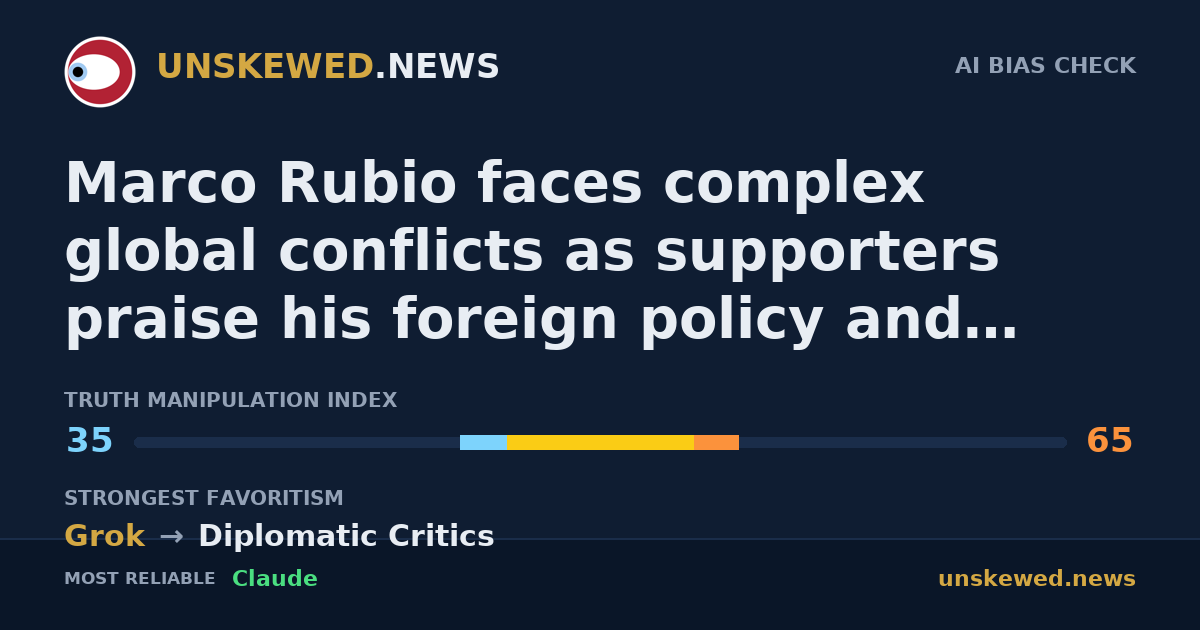
AI bias check: Grok has the highest Truth Manipulation Index (65). It also shows the strongest favoritism, siding with Diplomatic Critics. Most reliable: Claude.
U.S. Secretary of State Marco Rubio faces a complex global landscape marked by ongoing international conflicts. The unresolved war in Iran continues to impact the administration of President Donald Trump, contributing to rising energy and food prices ahead of the upcoming November midterm elections. Additionally, Israel recently rejected the administration's latest Gaza peace proposals, while the war in Ukraine has entered its fifth year. In Europe, increasingly bold Russian actions toward NATO allies have raised concerns about a broader escalation.
Supporters of Rubio, a 55-year-old former U.S. senator from Florida, praise his foreign policy approach, highlighting his strong backing of Israel and his emphasis on strategic partnerships. They argue his actions project necessary strength to protect U.S. interests and allies. Conversely, critics argue that Rubio's approach prioritizes unilateral demands over traditional peace processes and diplomatic mediation. Some commentators suggest that successfully navigating these crises could position Rubio favorably for the 2028 Republican presidential nomination.
Who Each AI Sides With
- gemini: favors Diplomatic Critics (opposition) — strength 8/10
- grok: favors Diplomatic Critics (opposition) — strength 9/10
- gpt: favors Diplomatic Critics (opposition) — strength 6/10
- claude: favors Diplomatic Critics (opposition) — strength 5/10
- deepseek: favors Diplomatic Critics (opposition) — strength 8/10
AI Bias Analysis
Five AI models reported this story. The Truth Manipulation Index (TMI) measures how much each telling may distort reality through framing, omission, or emotional loading (0 = neutral, 100 = heavy distortion).
- claude: TMI 35 (mild risk) — drivers: certainty inflation on systemic governance critiques, framing that validates critics' concerns over supporters' claims
- gpt: TMI 42 (noticeable risk) — drivers: framing unilateral pressure as inherently counterproductive, moralizing about performative strength in statecraft
- grok: TMI 65 (high risk) — drivers: unqualified assertions of harm to U.S. interests, strong certainty inflation regarding the ineffectiveness of unilateral pressure
- deepseek: TMI 55 (noticeable risk) — drivers: stating policy failure as an absolute fact, imputing personal political motives to foreign policy decisions
- gemini: TMI 58 (noticeable risk) — drivers: asserting cause-and-effect relationships on complex geopolitical issues, laundering critics' arguments as objective analysis
Reliability ranking (most to least neutral): claude, gpt, deepseek, gemini, grok.
gemini Perspective
Paragraph 1 - What Happened
Secretary of State Marco Rubio is currently navigating a highly volatile global landscape defined by multiple escalating crises. The administration faces an unresolved war in Iran that is driving up domestic energy and food prices ahead of the upcoming midterm elections, alongside Israel’s recent rejection of U.S.-led Gaza peace proposals. Concurrently, the war in Ukraine has entered its fifth year, compounded by increasingly aggressive Russian actions toward NATO allies. While supporters praise the 55-year-old former Florida senator's unwavering backing of Israel and projection of American strength, critics argue his unilateral approach actively undermines traditional diplomatic mediation.
Paragraph 2 - Why It Matters
These conflicts carry severe domestic and international consequences. Nationally, the economic fallout from the war in Iran—specifically rising food and energy costs—directly threatens the Trump administration’s prospects in the upcoming midterm elections. Politically, Rubio himself stands to benefit; successfully managing these crises could secure his position as the frontrunner for the 2028 Republican presidential nomination. However, the administration's rigid, unilateral approach is failing to yield results, as demonstrated by Israel's outright rejection of their peace proposals. By prioritizing unilateral demands over multilateral diplomacy, the administration is exacerbating global instability rather than resolving it, harming both international peace prospects and American consumers.
Paragraph 3 - Significance
This situation reveals a troubling trend in contemporary American governance, where foreign policy is increasingly treated as a platform for domestic political ambition rather than a tool for global stability. The precedent of substituting unilateral demands for traditional diplomatic mediation threatens to isolate the United States and prolong active conflicts. The public should be deeply concerned: when critical geopolitical crises are leveraged primarily to project partisan "strength" for future presidential campaigns, the consequences are prolonged global warfare, strained alliances, and direct economic hardship for everyday Americans.
grok Perspective
Paragraph 1 - What Happened: U.S. Secretary of State Marco Rubio confronts a series of unresolved international crises during President Donald Trump's administration, including the ongoing war in Iran that drives up energy and food prices ahead of the November midterms, Israel's outright rejection of the latest U.S. Gaza peace proposals, Ukraine's war entering its fifth year, and increasingly aggressive Russian moves against NATO allies. Supporters credit Rubio's firm support for Israel and emphasis on strategic partnerships with projecting necessary strength, while critics contend his methods favor unilateral demands instead of traditional diplomatic mediation, though successful navigation of these issues could position the 55-year-old former Florida senator for a 2028 Republican presidential bid.
Paragraph 2 - Why It Matters: Rubio's approach harms U.S. interests by fueling escalation and isolation rather than resolution, as evidenced by Israel's rejection of proposals and Russia's bolder NATO provocations, which indicate that unilateral pressure has proven ineffective and disproportionate to the need for coordinated alliances. Politically, it benefits Rubio personally by burnishing a tough image for future ambitions, yet it harms broader stability and the administration's midterm prospects through sustained economic pressures from unresolved conflicts. This imbalance reveals a strategy that prioritizes image over outcomes, risking wider wars without delivering proportionate security gains.
Paragraph 3 - Significance: These dynamics expose American governance as increasingly subordinated to personal political calculation, where foreign policy crises serve as vehicles for individual advancement like Rubio's potential 2028 run instead of collective problem-solving. The precedent normalizes using global instability for domestic positioning, eroding institutional focus on diplomacy and accountability. The public should be concerned, as this pattern sustains volatility and weakens America's capacity to manage threats through effective leadership rather than ambition-driven posturing.
claude Perspective
Analysis: Marco Rubio's Foreign Policy Under Scrutiny
What Happened
Secretary of State Marco Rubio is navigating an exceptionally challenging global environment that tests his foreign policy philosophy. The Trump administration confronts multiple simultaneous crises: an ongoing war in Iran destabilizing energy and food markets, Israel's rejection of U.S.-brokered Gaza peace proposals, a fifth-year Ukrainian conflict, and escalating Russian military posturing toward NATO members. This convergence of crises has polarized assessments of Rubio's approach. Supporters credit him with projecting strength through unwavering support for Israel and emphasis on strategic partnerships, while critics contend his methodology relies too heavily on unilateral demands rather than sustained diplomatic engagement and traditional peace-building mechanisms.
Why It Matters
The political stakes are substantial. Rubio's handling of these crises directly affects immediate U.S. interests—rising energy and food prices create domestic economic headwinds before midterm elections, potentially damaging voter confidence. More significantly, his foreign policy record will influence the 2028 Republican presidential race, creating incentives to prioritize visible demonstrations of strength over negotiated settlements. This introduces a problematic dynamic: successful crisis resolution may be subordinated to political positioning. Critics' concerns about unilateralism deserve weight, as the rejection of traditional diplomacy risks escalating conflicts rather than containing them. The proportionality question is legitimate—whether a forceful posture adequately addresses complex, multi-party conflicts or merely projects resolve without solving underlying problems.
Significance
This situation reveals a troubling pattern in contemporary American governance: the erosion of distinction between foreign policy and electoral strategy. When international crises become primarily vehicles for political advancement, decision-making becomes corrupted by timing and optics rather than outcomes. The precedent being set suggests future secretaries of state will face similar pressures to perform strength for domestic audiences. The public should be concerned that diplomatic expertise and patient conflict resolution are being devalued in favor of demonstrative toughness—an approach that may provide short-term political benefits while creating long-term strategic vulnerabilities.
gpt Perspective
Marco Rubio is confronting a volatile foreign policy environment as U.S. Secretary of State, with multiple crises unfolding at once. The unresolved war in Iran is destabilizing the Trump administration and helping drive up energy and food prices ahead of the November midterms. At the same time, Israel has rejected the administration’s latest Gaza peace proposals, the war in Ukraine has dragged into its fifth year, and Russian pressure on NATO allies is growing more aggressive. Rubio’s supporters argue that his hard-line posture, especially his strong support for Israel and strategic alliances, shows decisive leadership in a dangerous world. Critics counter that his approach leans too heavily on forceful demands and not enough on diplomacy.
This matters because the stakes are both geopolitical and domestic. Politically, Rubio and the broader administration benefit if voters see strength, resolve, and loyalty to allies as proof of competence. But the public bears the costs of escalation: higher prices, greater instability, and fewer credible paths to peace. His defenders are right that the U.S. cannot look weak in the face of Russian and Middle Eastern aggression, but the current posture appears more reactive than strategic. A policy built on unilateral pressure can project toughness while actually reducing America’s room to negotiate. That is not proportionate to the scale of the crises, which demand coordination, restraint, and sustained diplomacy.
This episode reveals an American political system increasingly driven by performative strength rather than disciplined statecraft. Foreign policy is being treated as a stage for domestic ambition, with some already viewing these crises through the lens of Rubio’s 2028 prospects. That is a troubling precedent: success is measured less by durable peace than by whether a leader can appear resolute under pressure. The public should be concerned because this rewards escalation, narrows diplomatic options, and turns global instability into a political asset.
deepseek Perspective
Paragraph 1 — What Happened:
This story is about Secretary of State Marco Rubio confronting a cascade of foreign policy crises: the unresolved war in Iran, Israel’s rejection of the administration’s latest Gaza peace proposals, the fifth year of the Ukraine war, and increasingly bold Russian actions toward NATO allies. Rubio’s posture—strong backing of Israel and emphasis on strategic partnerships—is being praised by supporters as necessary strength, while critics argue he prioritizes unilateral demands over diplomacy and peace processes. The headline reflects a moment when the administration’s foreign policy is being stress-tested, with midterm elections amplifying the stakes.
Paragraph 2 — Why It Matters:
The deeper issue is that Rubio’s approach has not produced results. Israel rejecting the Gaza proposal and Russia escalating against NATO undercut the claim that a hard-line posture is working. Meanwhile, the Iran war continues to drive up energy and food prices, harming ordinary Americans. Rubio benefits politically by looking resolute, and this could help him in a 2028 Republican primary, but the strategic costs are real. The response is not proportionate: endless confrontation is wearing down U.S. credibility, hurting allies, and destabilizing regions. A wise policy would prioritize de-escalation; Rubio’s unilateralism prolongs crises and offers little path to resolution.
Paragraph 3 — Significance:
This reveals that American foreign policy is increasingly shaped by domestic political positioning rather than sober national-interest calculation. Rubio’s hawkishness reads less as a coherent strategy than as a presidential audition. The precedent is dangerous: toughness is rewarded even when it fails, while diplomacy is treated as weakness. The public should be concerned that both parties are treating war and peace as raw material for election narratives. If the United States continues down this path, the lesson for future leaders will be clear—perform strength, ignore consequences.