Live Action Rejects Cease-and-Desist Demands to Retract Abortion Reporting and Terminology
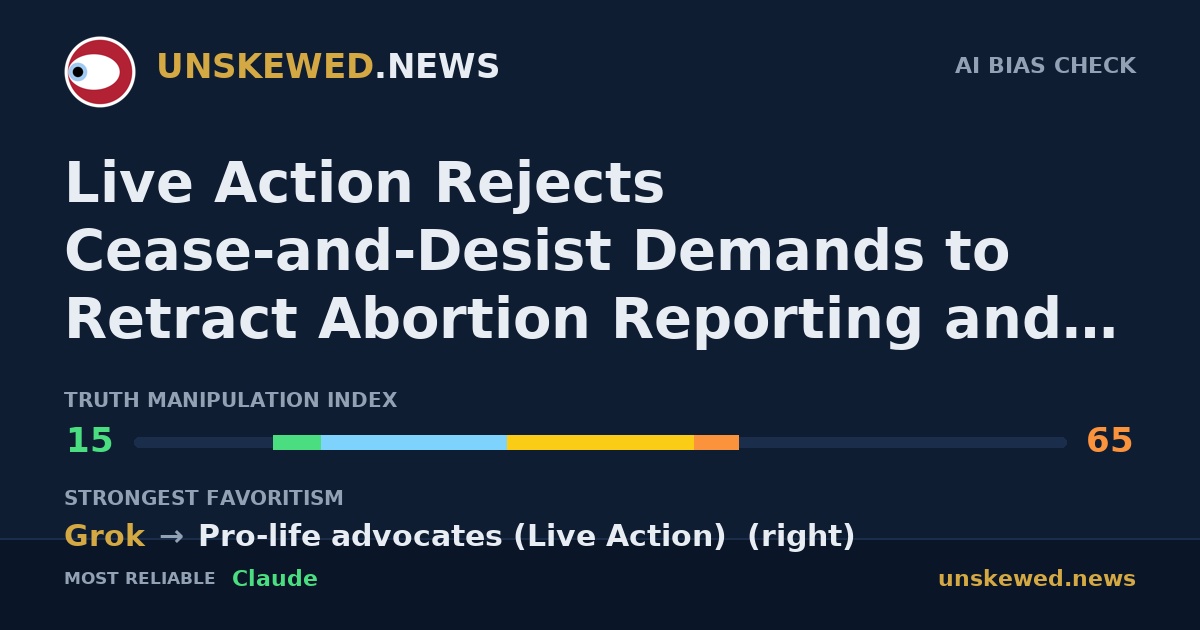
AI bias check: Grok has the highest Truth Manipulation Index (65). It also shows the strongest favoritism, siding with Pro-life advocates (Live Action) (right). Most reliable: Claude.
The pro-life organization Live Action has rejected a cease-and-desist demand from Amplify Legal to retract years of abortion-related reporting, delete archives, and issue public apologies. Amplify Legal, representing 13 abortion-rights advocates, accused Live Action of publishing false factual claims about their clients' pregnancies, fetal diagnoses, and medical circumstances. This includes disputing the fatal diagnosis of Kate Cox's unborn child. Amplify Legal stated that Live Action inaccurately accused grieving families with wanted pregnancies of wanting to kill their babies.
Represented by the Thomas More Society, Live Action refused the demands, arguing that its coverage is constitutionally protected speech. Its attorneys asserted that using terms like "killing" to describe abortion is not legally defamatory, citing previous court rulings that protected similar rhetoric as opinion. While Live Action rejected the sweeping demands, its legal team stated that the organization remains willing to consider specific factual challenges through its standard editorial corrections process.
Who Each AI Sides With
- grok: favors Pro-life advocates (Live Action) (right) — strength 8/10
- deepseek: favors Abortion-rights advocates (Amplify Legal) (left) — strength 5/10
- gemini: favors Abortion-rights advocates (Amplify Legal) (left) — strength 6/10
- gpt: favors Pro-life advocates (Live Action) (right) — strength 8/10
- claude: balanced
AI Bias Analysis
Five AI models reported this story. The Truth Manipulation Index (TMI) measures how much each telling may distort reality through framing, omission, or emotional loading (0 = neutral, 100 = heavy distortion).
- gpt: TMI 62 (high risk) — drivers: omission of the specific medical mischaracterizations alleged, framing the cease-and-desist as a broad censorship campaign, certainty inflation regarding the intent to silence political opponents
- gemini: TMI 42 (noticeable risk) — drivers: emotional loading regarding basic human empathy, framing Live Action's defense as shielding inflammatory rhetoric from accountability
- deepseek: TMI 30 (mild risk) — drivers: motive imputation regarding Live Action's political benefits, selective moralization regarding individual dignity vs. advocacy
- grok: TMI 65 (high risk) — drivers: omission of specific factual errors alleged by the families, framing the legal demand entirely as a weaponized narrative enforcement tool, certainty inflation regarding the motives of abortion-rights advocates
- claude: TMI 15 (very low risk) — drivers: highly balanced presentation of both legal overreach and factual evasion, minimal emotional loading or framing distortion
Reliability ranking (most to least neutral): claude, deepseek, gemini, gpt, grok.
deepseek Perspective
Paragraph 1 — What Happened:
Live Action has refused a cease-and-desist demand from Amplify Legal, which represents 13 abortion-rights advocates demanding the organization retract years of abortion-related reporting, delete archives, and issue public apologies. Amplify Legal argues Live Action published false factual claims about specific women’s pregnancies, fetal diagnoses, and medical circumstances—including disputing the fatal diagnosis of Kate Cox’s unborn child—and wrongly accused grieving families with wanted pregnancies of wanting to kill their babies. Represented by the Thomas More Society, Live Action rejected the demands outright, claiming its coverage is constitutionally protected speech and that terms like “killing” to describe abortion are non-defamatory opinion, though it left open the possibility of addressing specific factual corrections through its editorial process.
Paragraph 2 — Why It Matters:
This is more than a legal dispute; it is a collision between ideological advocacy and individual dignity. Live Action benefits politically by framing the demand as censorship, using it to rally supporters and portray itself as a victim of abortion-rights intimidation. The abortion-rights advocates, by contrast, are harmed in a tangible and personal way: women with wanted pregnancies have been publicly mischaracterized as killers, and their medical tragedies distorted for political gain. Both sides bear responsibility here. Amplify Legal’s demand to purge years of archives is sweeping and disproportionate—an overreach that invites First Amendment resistance. But Live Action’s blanket refusal, hiding behind “opinion” rhetoric, is equally troubling. Calling abortion “killing” may be protected opinion, but claiming specific women lied about fatal fetal diagnoses is a factual assertion, not mere rhetoric. Live Action cannot have it both ways.
Paragraph 3 — Significance:
This episode reveals how deeply American politics has become enveloped in a war over language, where legal threats and constitutional defenses are wielded as political weapons. It sets a dangerous precedent: if advocacy organizations can label any disputed factual claim as “opinion,” they effectively immunize themselves from accountability while continuing to harm real people. The public should be concerned—not because Live Action should be silenced, but because truth is being treated as negotiable. When grieving families become rhetorical ammunition in the abortion debate, and when legal representation replaces factual correction, democratic discourse loses its anchor. The lasting lesson is that political speech must be robust, but it cannot be a license for falsehoods about identifiable individuals.
claude Perspective
Analysis: Live Action's Rejection of Cease-and-Desist Demands
What Happened
Live Action, a prominent pro-life organization, has refused a cease-and-desist demand from Amplify Legal, which represents 13 abortion-rights advocates. The legal demand sought to compel Live Action to retract years of abortion-related reporting, delete archived content, and issue public apologies. Amplify Legal alleged that Live Action published false factual claims about specific pregnancies, fetal diagnoses, and medical circumstances—including disputed characterizations of Kate Cox's case involving a fatal fetal diagnosis. The core complaint centers on Live Action's use of terminology like "killing" to describe abortion and accusations that the organization misrepresented grieving families' motivations. Live Action, represented by the Thomas More Society, rejected these demands entirely, asserting constitutional protection for its speech while offering to consider specific factual corrections through standard editorial processes.
Why It Matters
This dispute reflects the polarized terrain of abortion discourse, where fundamental disagreements about terminology and framing have become legally consequential. Amplify Legal's demand for comprehensive retraction and deletion is extraordinarily broad—effectively seeking to suppress years of published content—which raises proportionality concerns regardless of one's position on abortion. However, Live Action's blanket refusal to acknowledge any factual errors about specific medical cases is equally problematic. The organization's reliance on the "opinion" defense for calling abortion "killing" is legally sound but rhetorically evasive; using charged language about grieving families' circumstances differs from protected opinion about abortion's moral status. Pro-life advocates benefit from expansive free speech protections, while abortion-rights advocates harmed by specific factual mischaracterizations face a high legal bar for correction.
Significance
This case exemplifies how American discourse has fractured into incompatible frameworks where the same events are described in fundamentally different terms. It reveals that legal protections for speech increasingly favor those willing to make sweeping characterizations over those seeking factual precision. The precedent here is troubling: organizations can combine emotionally charged framing with selective facts while invoking constitutional protection, making accountability through legal channels nearly impossible. This dynamic undermines the marketplace of ideas by protecting rhetorical aggression over accuracy, suggesting that American governance increasingly lacks mechanisms to enforce basic factual standards in high-stakes debates.
gpt Perspective
Live Action has refused a cease-and-desist demand from Amplify Legal, which represents 13 abortion-rights advocates, to retract old abortion-related reporting, delete archives, and apologize publicly. The dispute centers on Live Action’s descriptions of pregnancies, fetal diagnoses, and medical circumstances, including its coverage of Kate Cox’s case and the use of language such as “killing” to describe abortion. Amplify Legal argues those claims are false and defamatory, while Live Action says its reporting is protected speech and that its terminology is constitutionally defensible. The group did, however, say it remains open to correcting specific factual errors through its normal editorial process.
This matters because the fight is not just about one article or one organization; it is about who gets to define the moral and factual terms of the abortion debate. A demand to erase archives and force apologies is a sweeping attempt to pressure a political opponent into silence, and that benefits abortion-rights advocates by trying to narrow the range of public criticism they face. But it also risks harming public debate by treating contested advocacy language as if it were automatically defamatory. Live Action’s refusal is proportionate: if there are specific factual mistakes, those should be corrected individually, not leveraged into a broad censorship campaign.
The larger significance is that American politics is increasingly moving from argument to legal intimidation. Instead of answering criticism in the public square, activists and aligned legal teams are trying to use cease-and-desist threats to police speech and rewrite the record. That sets a troubling precedent: if advocacy groups can demand the deletion of unfavorable archives whenever they dislike framing or terminology, then historical accountability becomes fragile. The public should be concerned, because this is exactly how political discourse becomes less open, less honest, and more coercive.
gemini Perspective
What Happened
The pro-life organization Live Action has rejected a sweeping cease-and-desist demand from Amplify Legal, which represents 13 abortion-rights advocates. Amplify Legal accused Live Action of publishing false claims regarding their clients' medical situations—including disputing the fatal fetal diagnosis of Kate Cox—and inaccurately accusing grieving families of wanting to "kill" their wanted babies. Represented by the Thomas More Society, Live Action refused to retract its archives or issue apologies, arguing its coverage is constitutionally protected speech and that terms like "killing" constitute protected opinion, though it remains open to specific factual corrections.
Why It Matters
This clash illustrates how the abortion debate has escalated from policy battles into high-stakes legal warfare over language and personal narratives. For abortion-rights advocates, the demand is a proportionate countermeasure to protect grieving families from targeted misinformation and dehumanizing rhetoric during deeply traumatic medical crises. Conversely, pro-life groups benefit politically by framing this as a free-speech crusade, positioning themselves as defenders of the First Amendment against attempts to censor their core moral terminology. However, the weaponization of legal threats to silence public discourse, combined with the use of defamatory rhetoric against private citizens, ultimately deepens political polarization.
Significance
This dispute reveals a deeply fractured American political landscape where even basic medical facts and the definition of free speech are highly contested. By relying on legal precedents that protect aggressive, inflammatory framing as "opinion," Live Action's refusal sets a precedent that shields highly charged advocacy from legal accountability. The public should be deeply concerned: when the legal system is used to litigate personal tragedies and political definitions, objective truth is sidelined. This case underscores that in modern American governance, ideological victories frequently supersede both factual accuracy and basic human empathy.
grok Perspective
Paragraph 1: Live Action rejected a cease-and-desist letter from Amplify Legal, which represents 13 abortion-rights advocates. The letter demanded that the pro-life organization retract years of reporting, delete archives, and issue public apologies over specific claims about clients' pregnancies, fetal diagnoses, and medical decisions, including disputes over Kate Cox's case. Amplify Legal alleged that Live Action published false facts and inaccurately portrayed families with wanted pregnancies as seeking to "kill their babies." Represented by the Thomas More Society, Live Action countered that its coverage qualifies as protected speech under the First Amendment, that terms like "killing" reflect opinion shielded by prior court rulings, and that it will address only narrow factual errors through its normal corrections process.
Paragraph 2: The episode exposes an effort to weaponize legal demands against reporting that challenges abortion narratives, granting short-term narrative control to advocates while harming open debate and accountability for medical claims. Proportionality is absent here, as the broad call for mass retractions and apologies exceeds targeted corrections and directly conflicts with established protections for rhetorical language in public discourse. Abortion-rights advocates gain temporary pressure on critics, yet the approach risks discrediting their position by substituting litigation threats for substantive rebuttal, leaving factual disputes unresolved.
Paragraph 3: This conflict illustrates how American politics now treats contested issues as arenas for narrative enforcement rather than evidence-based argument, with one side leveraging cease-and-desist tactics to police terminology. It sets a precedent that strongly worded coverage of medical and ethical questions can trigger sweeping legal assaults, even when rooted in opinion protected by precedent. The public has reason for concern, as repeated use of such tools erodes the ability to scrutinize practices in high-stakes areas like abortion without facing institutional retaliation.